
A 4-layer muslin blanket is made through a specialized weaving and finishing process. Unlike conventional quilted blankets, its four fabric layers are connected during weaving through yarn interlacing rather than stitched together afterward. Washing and relaxed finishing then create the naturally crinkled texture that makes multi-layer muslin distinctive.
At Mefiss Hometex, we develop textile products using different fabric structures and finishing techniques for baby brands, home textile retailers, and private-label customers. Understanding how four-layer muslin is manufactured helps brands make better decisions when developing their own blanket collections.
In this guide, we explain the complete manufacturing process, from multi-layer weaving and binding point design to washing, shrinkage control, cutting, and edge finishing.
1. What Is a 4-Layer Muslin Blanket?
A 4-layer muslin blanket consists of four layers of lightweight gauze fabric connected into one integrated textile structure. The layers are joined through woven binding points rather than assembled by sewing four separate fabric sheets together.
Unlike a conventional quilt, a one-piece woven four-layer muslin blanket does not require a separate polyester filling layer between the fabric surfaces. The four gauze layers themselves form the blanket structure.
This construction has several distinctive characteristics:
- Integrated four-layer construction: All four layers are connected during weaving.
- Natural crinkle texture: Washing and fabric relaxation create the characteristic raised surface.
- Air spaces between layers: The multi-layer construction creates small spaces within the fabric.
- Flexible finishing options: The finished fabric can be cut into different blanket sizes and completed with various edge treatments.
For baby and home textile brands, this structure provides a distinctive fabric appearance without adding a separate bulky filling layer.
2. How Are Four Muslin Layers Connected During Weaving?
The most important manufacturing stage is weaving. Four-layer muslin is not simply made by stacking four sheets of gauze and sewing them together afterward. Instead, the four layers are formed and connected directly on the loom.
2.1. Multi-Beam Weaving Creates Four Fabric Layers
Multi-beam weaving equipment, including air-jet or rapier looms, is used to produce this integrated structure.
Four warp systems are supplied simultaneously to form four independent gauze layers within the same textile structure. During weaving, selected yarns interlace between the layers at predetermined positions to create binding points.
2.2. How Do Woven Binding Points Hold the Layers Together?
Binding points are formed by yarn interlacing during weaving. They are not sewing stitches and do not require quilting thread to pass through the blanket.
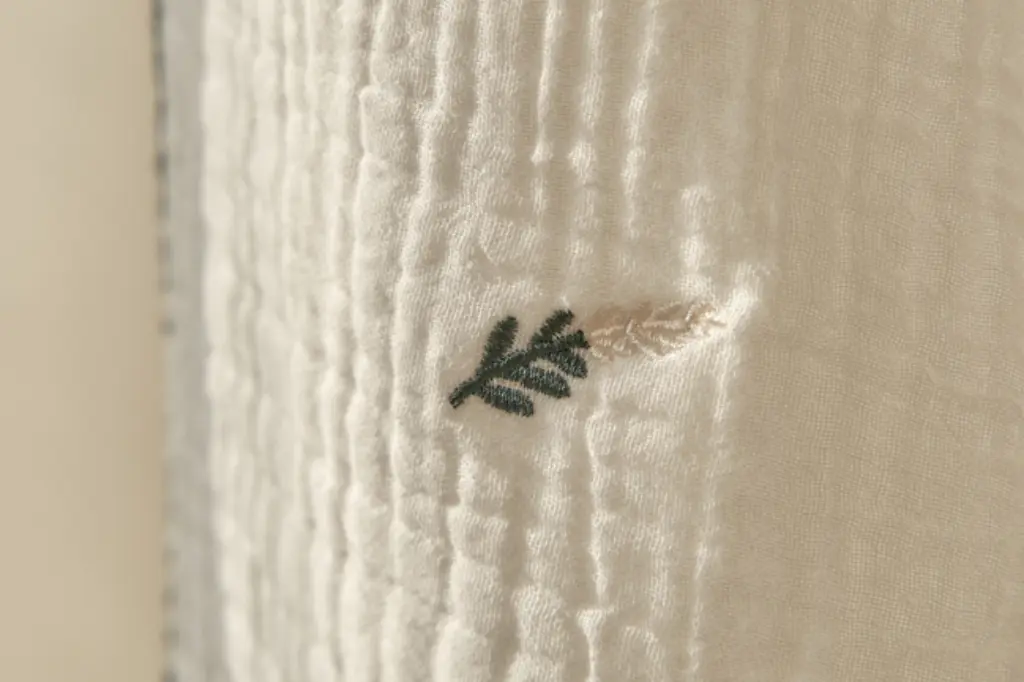
These woven connection points hold the four layers together while preserving spaces between them. After washing and relaxed finishing, the surrounding fabric contracts and develops the characteristic three-dimensional crinkle texture.
The spacing of binding points is an important fabric design parameter:
- Closer binding points: Create smaller crinkles and a flatter surface appearance.
- Wider binding-point spacing: Creates larger, more pronounced crinkles and a fuller appearance.
2.3. How Does Yarn Selection Affect Four-Layer Muslin?
The four layers do not have to use exactly the same yarn specification.
One option is to use the same yarn count throughout all four layers. Another option is to use finer yarns for the outer layers and coarser yarns for the inner layers.
Different yarn combinations allow fabric developers to adjust surface softness, fabric fullness, and warmth while maintaining the integrated four-layer construction.
3. Why Does Washing Create the Signature Muslin Crinkle Texture?
Washing is a critical part of four-layer muslin finishing. The characteristic crinkle texture is not pressed into the fabric by a quilting machine. It develops through fabric relaxation and shrinkage during washing and subsequent finishing.
3.1. The Four-Layer Muslin Finishing Process
The main finishing stages include:
- Greige fabric preparation: The woven four-layer fabric is prepared for finishing.
- Desizing: Remaining sizing materials are removed.
- Pre-shrinking: Controlled washing helps reduce subsequent dimensional changes.
- Enzyme washing: Residual sizing materials and cotton wax are removed to improve the fabric surface.
- Drying: Moisture is removed after washing.
- Relaxed finishing: The fabric is finished under relaxed conditions to preserve its natural texture.
During washing and relaxed finishing, the fabric contracts naturally around the woven binding points. This produces the raised crinkle appearance associated with four-layer muslin.
3.2. How Does Pre-Shrinking Help Control Fabric Shrinkage?
Pre-shrinking is an important step in cotton gauze production. Unprocessed greige fabric can experience considerable dimensional changes during its first wash if it has not received appropriate shrinkage treatment.
For our pre-shrunk gauze fabrics, the shrinkage rate can be controlled within 5% under the applicable national standard.
This makes pre-shrinking an essential part of fabric development, rather than simply a treatment used to create the final appearance.

4. One-Piece Woven Muslin vs. Four Separate Layers with Quilting
Not every blanket described as a four-layer blanket uses the same manufacturing method. Two different construction methods should be distinguished.
4.1. One-Piece Woven Four-Layer Gauze
In this method, all four layers are formed and connected during weaving. Binding points are created through yarn interlacing, so the fabric leaves the loom as one integrated structure.
After washing and finishing, the fabric is cut according to the required blanket dimensions. Production then focuses mainly on edge finishing, brand labels, and other decorative details.
This is the main construction method we use for our four-layer muslin blanket development.
4.2. Four Separate Gauze Layers Fixed by Quilting
Another method uses four independent sheets of single-layer gauze. The sheets are laid on top of one another, aligned, and cut before being joined with a multi-needle quilting machine.
Common quilting patterns include square grids and wave lines. Quilting thread passes through the fabric layers to hold them together.
This construction is closer to conventional quilt manufacturing. It is different from one-piece woven four-layer muslin because the layers are assembled after the individual fabrics have already been produced.
4.3. Key Manufacturing Differences
| Feature | One-Piece Woven | Quilted Layers |
|---|---|---|
| Construction | Four layers woven together | Four separate fabric sheets |
| Connection | Yarn interlacing | Quilting thread |
| Crinkle texture | Develops through washing and relaxation | Does not have the same woven crinkle structure |
| Full-surface stitching | Not required | Required |
| Main finishing | Edge finishing | Quilting and edge finishing |
One-piece woven muslin uses integrated binding points to connect the layers. It does not require full-surface quilting to hold the fabric structure together.

5. Which Fabric Specifications Can Be Customized?
For brands developing their own muslin blanket collections, customization goes beyond choosing a color or finished size. Several fabric specifications can be considered during product development.
5.1. Yarn Specifications Across Four Layers
All four layers can use the same yarn count, or the outer and inner layers can use different yarn specifications.
For example, finer yarns can be used on the outer surfaces while coarser yarns are used in the inner layers. Different combinations create different fabric characteristics while retaining the integrated four-layer construction.
5.2. Binding Point Density
The distance between woven binding points influences the final fabric appearance.
- Closer binding points create smaller crinkles and a flatter surface.
- Wider binding-point spacing creates larger and more pronounced crinkles.
Brands can use different binding point designs to create a distinctive fabric texture for their collections.
5.3. Colors and Printed Patterns
One-piece woven four-layer gauze can be developed with yarn-dyed colors or reactive printing.
For printed designs, patterns are applied to the surface layer while the integrated four-layer construction and binding points remain part of the fabric structure.
6. Cutting, Edge Finishing, and Custom Blanket Production
After weaving, washing, and finishing, the fabric is ready for conversion into finished blankets.
6.1. Cutting the Finished Fabric
The finished four-layer fabric is cut according to the required blanket dimensions.
Because the four layers are already connected during weaving, there is no need to stack and assemble four independent gauze sheets during blanket production.
6.2. Choosing the Edge Finishing Method
For one-piece woven four-layer muslin blankets, the main sewing work is concentrated around the edges.
Common finishing options include:
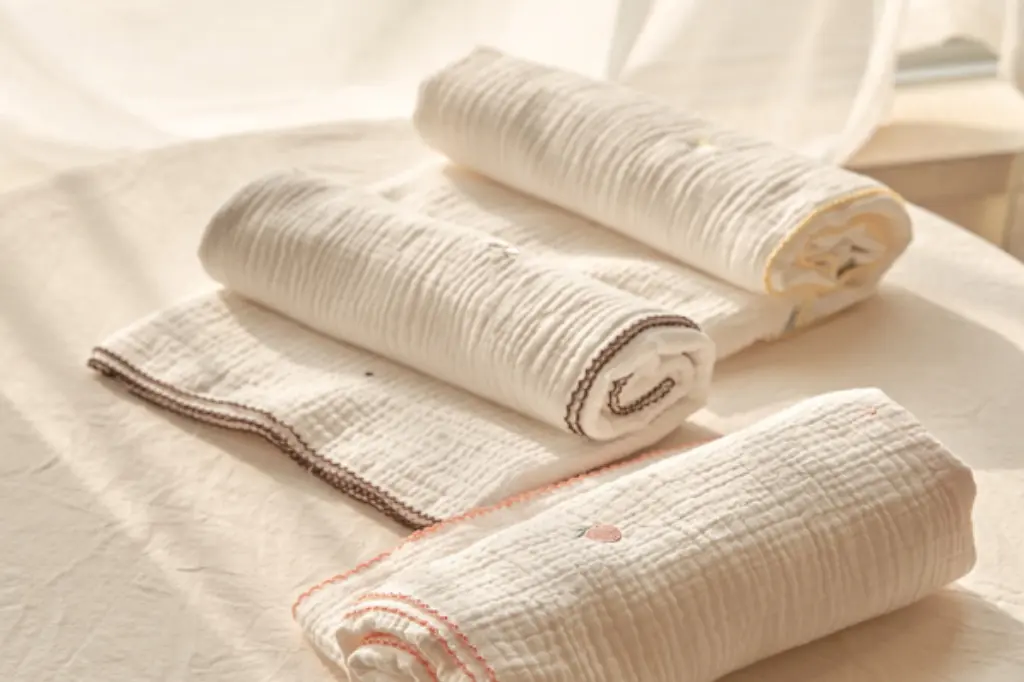
- Wide binding: Creates a more prominent finished edge.
- Narrow binding: Provides a simpler appearance.
- Fringed edges: Adds decorative textile details.
- Raw or frayed edges: Creates a relaxed textile style when specified in the design.
- Brand labels: Add brand identity and product information.
 6.3. Developing Custom Blankets for Different Brands
We support custom blanket development based on brand requirements, including fabric structure, yarn specifications, colors, patterns, finished dimensions, edge treatments, and brand labels.
Our blanket collection also includes products with other fabric constructions. For example, our exhibition presentation at the 2025 Tokyo International Gift Show included embroidered crinkle muslin blankets, demonstrating how textured gauze fabrics can be developed into differentiated home textile collections.
Explore our product collection and learn more about our participation in the 2025 Tokyo International Gift Show.
7. Frequently Asked Questions
7.1. Do Four-Layer Muslin Blankets Need Quilting?
Not necessarily. One-piece woven four-layer muslin is connected through yarn interlacing during weaving and does not require full-surface quilting. Four separate gauze layers can also be assembled through quilting, but this is a different manufacturing method.
7.2. What Creates the Crinkle Texture of Muslin Blankets?
The crinkle texture develops through fabric relaxation and shrinkage during washing and finishing. Woven binding points hold the four layers together while the surrounding fabric contracts and forms the raised texture.
7.3. Can the Four Layers Use Different Yarn Specifications?
Yes. All four layers can use the same yarn count, or the outer and inner layers can use different yarn specifications. This allows different combinations of surface softness and fabric fullness.
7.4. Can Four-Layer Muslin Blankets Be Printed?
Yes. One-piece woven four-layer gauze can be developed with yarn-dyed colors or reactive printing. Brands can create customized colorways and surface patterns for their collections.
7.5. How Is Shrinkage Controlled in Cotton Muslin?
Pre-shrinking is an important part of cotton gauze finishing. It helps reduce dimensional changes during subsequent washing. Our pre-shrunk gauze fabrics can achieve shrinkage control within 5% under the applicable national standard.
7.6. What Can Brands Customize When Developing a Muslin Blanket?
Customization options include yarn specifications, binding point density, fabric colors, reactive printing, blanket dimensions, edge finishing, and brand labels.
8. Conclusion: The Fabric Structure Makes the Difference
A four-layer muslin blanket is more than four sheets of gauze stacked together. Its construction begins during weaving, where four fabric layers are connected through yarn interlacing. Washing and relaxed finishing then create the natural crinkle texture that defines this type of textile.
At Mefiss Hometex, we focus on yarn specifications, binding point density, washing and finishing, and edge construction when developing muslin blanket products for our customers.
If you are developing your own four-layer muslin blanket collection, share your preferred fabric structure, yarn specifications, colors, blanket dimensions, edge finishing requirements, and estimated order quantity with us.
Develop Your Custom Muslin Blanket with Mefiss Hometex
Looking to develop a four-layer muslin blanket collection for your brand? Our team can help you develop your product and coordinate sampling and bulk production.
Visit Mefiss Hometex | Explore Our Products | Learn About Custom Product Development