

A pillow sample should be evaluated against clear product specifications before mass production begins. Checking dimensions, core firmness, cover construction, workmanship, and packaging at the sampling stage helps brands reduce costly changes during bulk manufacturing.
For pillow brands, approving a sample is more than confirming that the product looks right. The sample establishes the reference for the materials, dimensions, construction, and appearance expected in the finished order.
At Mefiss Hometex, material selection, sample development, and production consistency are important parts of finished pillow manufacturing. This guide explains the key checks buyers should complete before approving a pillow for mass production.
1|Confirm the Product Specifications Before Sampling
Before a factory starts developing a sample, the buyer should provide a clear product brief. Missing specifications can lead to repeated revisions because the buyer and manufacturer may have different expectations for the same product.
For a custom pillow, the brief should cover the following information:
- Dimensions: Finished length, width, height, and any required contour measurements.
- Core material: The selected foam, silicone foam, fiber filling, TPE tubes, 3D mesh, or combination structure.
- Firmness and support: The intended feel and the required support areas.
- Cover construction: Fabric composition, color, lining, zipper position, and removable-cover requirements.
- Branding and accessories: Brand labels, care labels, packaging, and other specified components.
- Packaging: Packaging type, finished package dimensions, and shipping requirements.
These details are particularly important when a pillow uses multiple materials or different support zones. A product combining 3D mesh with TPE tube filling, for example, needs clearly defined dimensions and a construction plan for each component.
For examples of different pillow constructions, explore the Mefiss finished product collection and our breathable baby pillow development approach.
2|Check Pillow Dimensions and Core Specifications
Dimensions are among the first items to check when evaluating a pillow sample. The core must match the agreed size and fit the cover properly. If the core is too large, the cover may become overstretched; if it is too small, the finished pillow may look loose or uneven.
2.1|Measure Length, Width, and Height
Measure the finished pillow according to an agreed measurement method. For contoured pillows, specify the reference points for height and other critical dimensions rather than relying on a single overall measurement.
The measurement method should remain consistent between sample approval and production inspection. Flexible foam, fiber-filled products, and structured mesh cores may respond differently to pressure during measurement, so the inspection method should suit the construction.
2.2|Check Firmness and Material Consistency
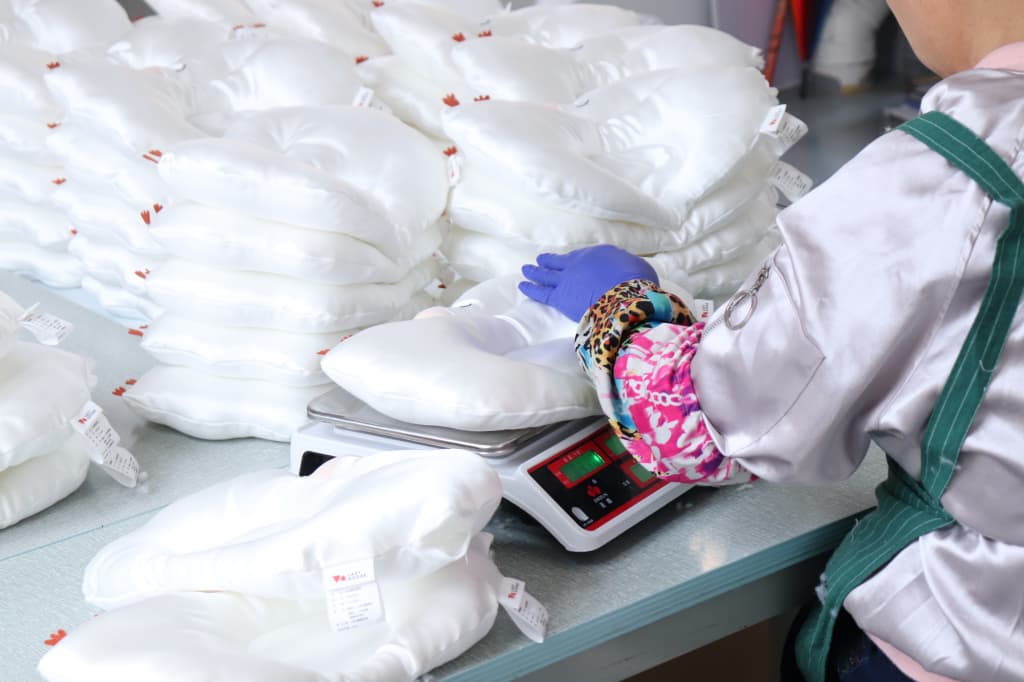
A pillow can meet its nominal dimensions and still feel different from the approved sample. For this reason, core firmness and material consistency should be evaluated alongside size.
At Mefiss, core thickness and firmness are subject to defined inspection requirements. Materials outside the applicable tolerance range are not selected for production. For a custom project, the buyer and manufacturer should establish the required specification before approving the sample.
Different core materials also require different evaluation methods. Memory foam is known for slow recovery, while silicone foam provides a more immediate elastic response. Fiber filling and tube-based structures have their own compression and recovery characteristics.
For technical information about mesh-based pillow structures, see our 3D mesh material page.
3|Evaluate the Pillow Cover and Construction Details
The cover is not simply an outer layer. Its dimensions, fabric properties, stitching, and closure design affect how the finished pillow looks and functions.
3.1|Check the Fit Between the Cover and Core
Place the core inside the cover and inspect the finished shape. The cover should fit the intended core structure without obvious bunching, excessive tension, or uneven distribution of the filling.
For pillows with multiple support zones or shaped cores, check whether the cover follows the intended contour. A cover pattern that does not match the core can affect both appearance and the way the pillow feels during use.
3.2|Inspect Stitching, Zippers, and Labels
Inspect the main seams, corners, zipper ends, and label attachment points. Check that the zipper opens and closes smoothly, the puller is secure, and the closure is positioned as specified in the approved design.
For removable covers, confirm that the core can be inserted and removed without unnecessary difficulty. Branding labels and care labels should also match the approved artwork, position, and product requirements.
These details are easier to correct during sample development than after a large quantity of finished pillows has been produced.
4|Use Real Product Examples to Check Different Specifications
A product family may include several versions that look similar but have different dimensions, core heights, or packaging requirements. Each version should be clearly identified in the approved specification.
For example, Mefiss’s FBA-232B silicone kids pillow is documented in three neck-support heights: 2 cm, 4 cm, and 6 cm. These are distinct product specifications and should not be treated as interchangeable during sample approval or production.

| FBA-232B Version | Documented Core Height | Sample Check |
|---|---|---|
| Model A | 2 cm | Confirm the specified height and product identification |
| Model B | 4 cm | Confirm the specified height and product identification |
| Model C | 6 cm | Confirm the specified height and product identification |
The product file also lists a box package size of 60 × 39 × 5 cm for this model family. Packaging dimensions should therefore be checked separately from the pillow’s finished dimensions.
This example illustrates why a product specification should identify each version clearly. When a buyer orders multiple heights, sizes, or material combinations, the sample and production documents should make each version easy to distinguish.
5|Approve a Pre-Production Sample Before Bulk Manufacturing
Before mass production begins, Mefiss develops a pre-production sample for the project. Once the sample is approved, bulk production should follow that confirmed reference.
The pre-production sample brings the agreed materials, construction, dimensions, and appearance together in one finished product. It gives both the buyer and manufacturer a clear reference for the production order.
Before approval, buyers should review:
- The finished dimensions and shape.
- The core material, firmness, and support structure.
- The cover fabric, color, stitching, zipper, and labels.
- The accessories and packaging configuration.
- Any product-specific requirements agreed during development.
If a change is made after sample approval, the revised specification should be documented clearly. This helps prevent the buyer and factory from working to different versions of the product.
Mefiss Manufacturing Insight: The approved pre-production sample should serve as the reference for bulk production. Confirming the details before manufacturing starts helps reduce avoidable differences between the approved product and the finished order.
6|Check the Finished Product and Packaging Before Shipment
Quality checks should continue during production and before shipment. A product may look correct as a sample, but the finished order still needs to be checked against the approved specifications.
For pillow products, the inspection checklist can include the following items, depending on the project requirements:
| Inspection Area | What to Check |
|---|---|
| Dimensions | Finished length, width, height, and specified contour measurements |
| Core | Material identification, firmness, thickness, and construction |
| Cover and sewing | Fabric, seams, zipper operation, labels, and overall appearance |
| Accessories | Correct labels, inserts, and other specified components |
| Packaging | Package dimensions, packaging type, product identification, and carton configuration |

For buyers who require a formal sampling plan, ISO 2859-1 provides procedures for inspection by attributes using acceptance quality limit principles. The appropriate inspection plan should be agreed according to the product, order, and buyer requirements.
For broader quality management guidance, buyers can also refer to the ISO 9001 quality management overview.
7|What Buyers Should Prepare Before Placing a Bulk Order
A clear specification package makes sample approval and bulk production more efficient. Before placing an order, buyers should organize the following information:
- Approved sample: The final sample that represents the required product.
- Product specification: Dimensions, core material, firmness, cover fabric, and construction details.
- Acceptable tolerances: The agreed dimensional and material requirements for the product.
- Artwork and labels: Final brand logo, care information, and label placement.
- Packaging specification: Package type, dimensions, carton quantity, and shipping requirements.
- Inspection requirements: Any agreed checks, sampling plans, or documentation required before shipment.
For customized pillows, the earlier these details are confirmed, the easier it is to align sampling, production, and packaging. Buyers can also review the 3D mesh vs. memory foam pillow comparison when deciding which core construction best matches their product concept.
8|Frequently Asked Questions
8.1|Why is a pre-production sample important?
It provides a confirmed reference for the product’s materials, dimensions, construction, appearance, and packaging. The factory can use the approved sample and specification to guide bulk production.
8.2|What should I check first when receiving a pillow sample?
Start with the overall dimensions, core height, firmness, and shape. Then check the cover fit, stitching, zipper, labels, and packaging against the agreed specification.
8.3|How can I reduce differences between samples and bulk orders?
Confirm the pre-production sample, document the approved materials and dimensions, define acceptable tolerances, and make sure any subsequent changes are recorded before production continues.
8.4|Should packaging be checked during sample approval?
Yes. Packaging type and dimensions affect storage, shipping, and carton configuration. They should be confirmed alongside the product specifications rather than left until the order is ready to ship.
8.5|Can Mefiss develop different pillow sizes or core heights?
Mefiss develops pillow products with different materials, structures, and specifications. Buyers should provide the required dimensions, core heights, intended use, and target market so the team can evaluate the appropriate development approach.
9|Conclusion: Approve the Details Before Production Starts
Reliable pillow quality starts with a clear specification and a well-defined sample approval process. Dimensions, core firmness, cover construction, stitching, labels, and packaging should all be reviewed before bulk production begins.
At Mefiss Hometex, pre-production sampling helps establish the product reference for mass manufacturing. When the sample, material requirements, and inspection criteria are clearly defined, buyers and manufacturers have a stronger basis for maintaining product consistency.
Develop Your Custom Pillow with Mefiss Hometex
Planning a new pillow or preparing for a bulk order? Share your product dimensions, core material, desired firmness, cover requirements, packaging specifications, target market, and estimated order quantity. Our team can help you define the sample requirements and development details for your project.
Explore Mefiss Products | Explore Pillow Development | Contact Mefiss Hometex