Choosing the right zipper construction for a removable mattress cover can make the difference between a product that is easy to maintain and one that is frustrating to remove, wash and reinstall. For mattress brands and OEM/ODM buyers, zipper design is not simply a question of accessory cost. It affects how the mattress core is handled, how the cover is manufactured and how conveniently the finished product can be maintained.
L-shaped, U-shaped and 360-degree zipper constructions are three useful approaches to consider. Each creates a different opening, but the best choice also depends on mattress dimensions, core thickness, material stiffness, fabric construction and the components that need to be removed.
This guide explains the practical differences between these zipper designs, how to evaluate them during mattress development and what buyers should confirm before approving an OEM or ODM sample. We will also look at documented construction details from Mefiss Hometex mattress models FBC-1M and FBC-1G.
1|L-Shaped vs. U-Shaped vs. 360-Degree Zipper Construction
The three terms describe the general route of the zipper around a mattress cover or removable component. However, zipper length alone does not determine whether a cover can be removed completely. That also depends on how the fabric panels are connected and whether the zipper is designed to separate.
1.1|L-Shaped Zipper: A Two-Sided Opening
An L-shaped zipper follows two adjacent sides of a mattress cover, typically one long side and one short side. When opened, it releases a corner section of the cover and creates access to the core.
This construction can be an efficient option for compact mattresses and thinner pads when the core can pass through the opening without excessive bending or pulling.
Potential advantages:
- A shorter zipper path than many three-sided or perimeter designs.
- Fewer zipper turns and a relatively straightforward sewing layout.
- Potential material and assembly cost savings, depending on the design.
- A practical opening for suitably sized and flexible mattress cores.
Potential limitations: The smaller opening may make removal and reinstallation more difficult as the mattress becomes larger, thicker or less flexible.
Importantly, an L-shaped zipper does not mean that only one corner of the cover can ever be cleaned. The complete cover may still be removable. The issue is how easily it can be taken off and put back on.
1.2|U-Shaped Zipper: A Wider Three-Sided Opening
A U-shaped zipper extends along three sides of a rectangular cover. Depending on the design, the path may follow one long side and two short sides, or another three-sided arrangement.
Once opened, a much larger section of the cover can be folded back. This gives users more space to lift out the core or position it correctly during reinstallation.
Potential advantages:
- A larger opening for handling thick or relatively firm mattress cores.
- Less need to force the core through a narrow corner opening.
- A useful balance between opening access and construction complexity.
- A practical option when larger removable covers need frequent handling.
Potential limitations: The longer zipper and additional turns require careful sewing, particularly where thick quilted panels or spacer mesh meet the zipper tape.
A U-shaped opening does not automatically mean that the cover remains permanently attached to the mattress. If it is a conventional removable outer cover, the entire cover can still be taken off the core.
1.3|360-Degree Zipper: Perimeter Access or a Detachable Component
A 360-degree zipper follows the perimeter of a cover component. In a fully separating design, it may allow two fabric panels or layers to be detached from each other.
This can be valuable for a reversible quilted mattress layer, a removable top panel or a construction in which specific components need to be cleaned separately.
Potential advantages:
- Access around the complete perimeter of the connected component.
- The possibility of fully separating panels when a suitable separating zipper is used.
- Convenient removal of selected quilted or reversible layers.
- Greater flexibility for certain multi-component mattress designs.
Potential limitations: A perimeter zipper generally requires more zipper length and more careful alignment. On a rectangular component, the route may pass around four corners, with the exact joint and end arrangement depending on the closure design.
A 360-degree zipper should not be confused with a certified allergen-proof encasement or a fire-resistant mattress barrier. Those functions depend on the entire product construction and applicable testing, not simply the zipper route.
| Feature | L-Shaped | U-Shaped | 360-Degree |
|---|---|---|---|
| Typical route | Two adjacent sides | Three sides | Component perimeter |
| Opening access | Corner opening | Wide panel opening | Perimeter opening or panel separation |
| Typical design use | Compact removable covers | Larger removable covers | Detachable or reversible layers |
| Cost consideration | Potentially less zipper material | Intermediate zipper length | Often greater zipper and assembly requirements |
| Key sampling check | Core removal through the opening | Panel fit and corner operation | Perimeter alignment and separation |
2|How Mattress Size, Thickness and Core Firmness Affect Zipper Selection
Mattress size is one of the most important factors when selecting a removable cover opening. As length and width increase, the core becomes more difficult to lift and position. A larger cover also means more fabric must be handled during removal and reinstallation.
However, size should never be evaluated alone. A thick, relatively rigid core may be harder to insert than a larger but more flexible one.
2.1|Compact and Children’s Mattresses
For a small mattress or thin pad, an L-shaped opening may provide enough access, particularly when the core can be handled easily and the cover fabric has suitable flexibility.
This can help simplify the construction without sacrificing usability. Nevertheless, children’s mattress designs should be evaluated against the intended product’s safety requirements, not only manufacturing cost.
2.2|Twin, Full and Queen Mattresses
As mattress dimensions increase, a three-sided opening becomes worth considering. Full and Queen-size covers, for example, may be more difficult to reinstall if the core must be pushed through a limited corner opening.
A U-shaped zipper can provide a wider opening and make it easier to align the cover with the core. This is especially relevant when the mattress uses a thicker quilted cover or a relatively firm core.
It is not a universal rule that every Full or Queen mattress requires a U-shaped zipper. The final decision should be based on actual handling tests.
2.3|King-Size and Other Large Mattress Designs
Large mattresses present additional challenges because the core may be heavy, bulky or difficult to bend. Removing a fitted cover may require more than one person, depending on the construction.
For these products, a U-shaped opening or a suitable perimeter-opening design may improve access. The development team should consider the complete assembly process rather than selecting the zipper solely by mattress size.
2.4|Why Thickness and Material Stiffness Matter
Consider two mattresses with identical length and width. One has a thin, flexible core, while the other has a thick, relatively firm construction with multiple textile layers.
The second mattress may require a wider opening because it is harder to bend and guide through the cover. Thicker cover materials also add bulk around the zipper and seams.
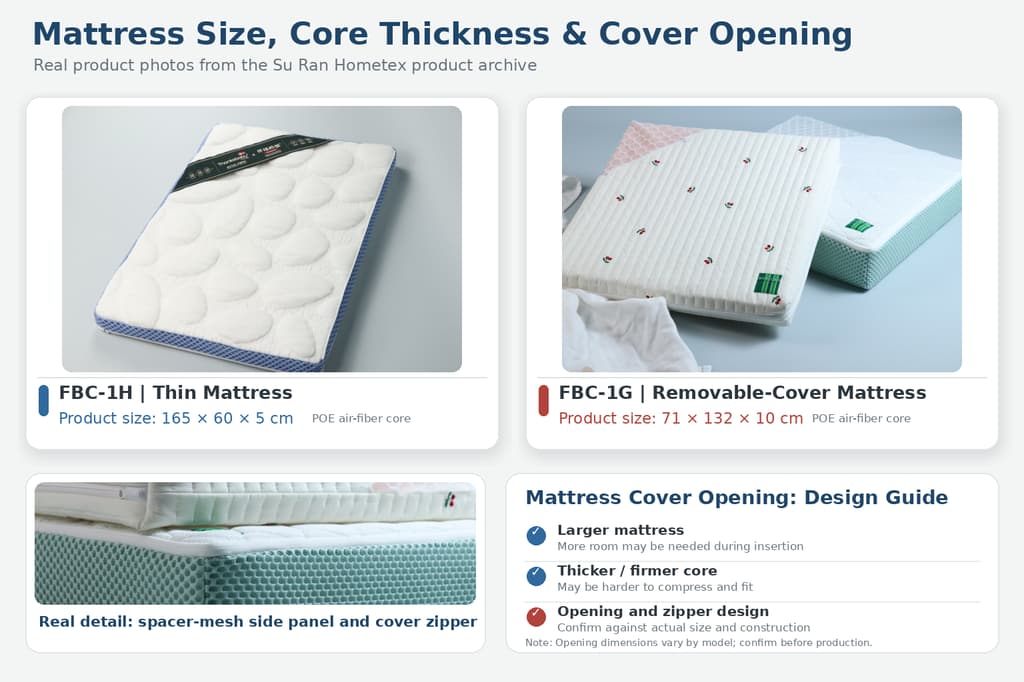
This is particularly relevant for some POE Air Fiber cores and thick spacer mesh constructions. Their three-dimensional structures may behave differently from soft, compressible foam.
For example, the POE Air Fiber cores described in the Mefiss mattress product specifications cannot be vacuum-compressed in the same way as conventional foam. This makes it important to test the real core and cover together during sampling.
You can learn more about this material in our POE Air Fiber material collection.
Practical Design Principle
As mattress size, thickness and core stiffness increase, the need for a wider opening often increases as well. Treat this as a starting point for design evaluation, not a fixed rule that applies to every mattress.
3|Why Removal Convenience Matters for Larger Mattress Covers
It is easy to underestimate the effort required to remove a mattress cover. A zipper may open smoothly on a sewing table, yet the finished cover may still be difficult to remove from the assembled mattress.
Several practical factors contribute to this problem.
3.1|Core Weight and Handling
A large mattress core may be difficult for one person to lift, rotate or bend. If the zipper opening is small, the user may need to move the core repeatedly to release the cover.
A wider opening can reduce unnecessary handling, although the total weight and dimensions still determine whether one-person removal is realistic.
3.2|Friction Between the Cover and Core
Some mattress covers combine knitted ticking, quilting, spacer mesh and other layers. The interaction between these surfaces and the core can create resistance during removal.
With a limited opening, the user may need to pull the cover around multiple corners. A wider opening can make the process more manageable.
3.3|Consumer Washing and Reinstallation
A washable cover should be practical to remove before washing and easy to reinstall afterward. If consumers struggle to put the cover back on, they may be less willing to follow the recommended care routine.
For larger covers, brands should also consider washing-machine capacity, care-label instructions and dimensional stability after washing. A removable cover is not automatically suitable for every household washing machine.
3.4|After-Sales Experience
An inconvenient opening may lead to consumer complaints about difficult removal, poor fit after washing or problems closing the zipper.
These risks can often be identified during sample evaluation. Having a person unfamiliar with the product remove and reinstall the cover can reveal practical issues that are not obvious during manufacturing.
4|Zipper Placement, Sewing Construction and Fabric Thickness
The zipper route is only one part of a successful design. Zipper position, fabric thickness, seam construction and puller selection also influence the finished product.
4.1|Where Should the Zipper Be Positioned?
For many mattress designs, the side gusset is a practical location because it keeps the zipper away from the main sleeping surface.
The development team should evaluate whether the zipper tape, teeth or puller could create a noticeable ridge, interfere with the intended surface or become difficult to access once the mattress is assembled.
A fabric zipper placket or puller cover may be considered when a more concealed finish is desired. However, the need for these features depends on the product design and applicable safety requirements.
The zipper should not be placed at a highly stressed or bulky seam intersection without evaluating how the surrounding fabric and stitching will perform.
4.2|Sewing Around Corners
Corners are important inspection points because the zipper must follow a change in direction while remaining smooth and functional.
Potential issues include uneven zipper tape feeding, fabric puckering, insufficient seam allowance and difficulty moving the slider around the turn.
Depending on the fabric and zipper specification, suitable seam reinforcement, stitching methods and corner allowances may be required. These details should be established during sampling rather than assumed to be identical for every product.
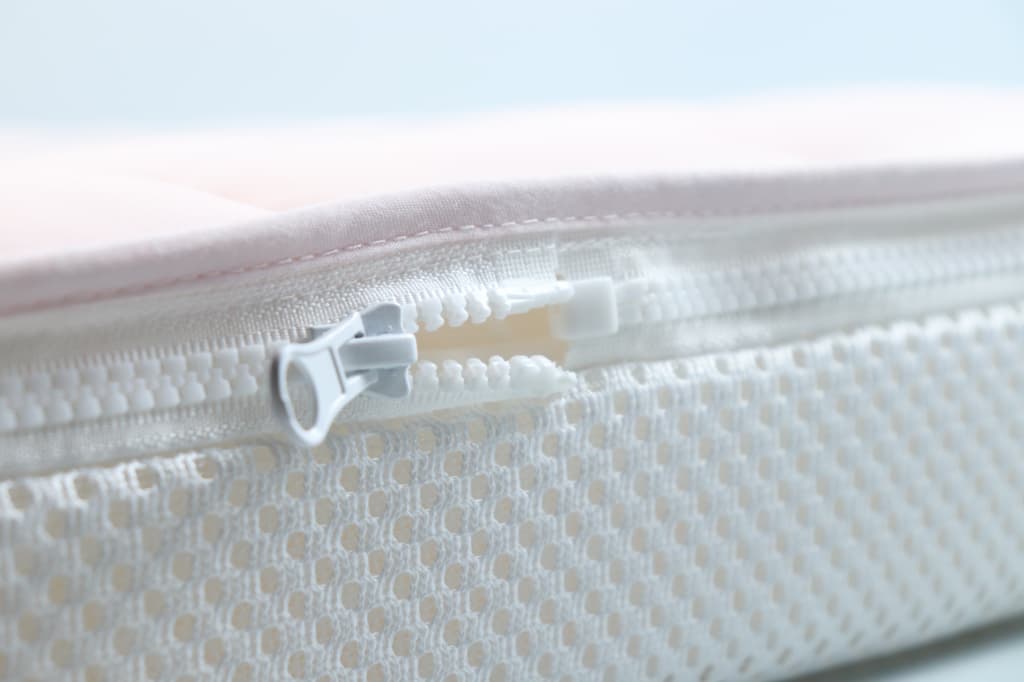
4.3|Working with Thick 3D Spacer Mesh
3D spacer mesh has a three-dimensional textile structure with surface layers connected by spacer yarns. Depending on thickness, density and finishing, it can behave differently from a thin knitted cover fabric.
When spacer mesh is used near a zipper, the sewing process may need to account for its thickness, compressibility and edge construction.
Important development considerations include:
- Appropriate needle and thread selection for the fabric combination.
- Suitable presser-foot pressure and fabric feeding.
- Enough seam allowance around thick or layered edges.
- Protection against loose yarns entering the zipper teeth.
- Checking whether a binding, facing or protective fabric strip improves the construction.
These are design considerations, not fixed requirements for every spacer mesh product. The appropriate method depends on the actual fabric specification.
Mefiss works with customized functional bedding and spacer mesh materials, allowing material and cover construction to be considered together during product development.
4.4|Choosing the Zipper Type and Slider
Nylon coil zippers are one option for flexible textile constructions because they can follow curved or angled sewing paths. The appropriate zipper size, tape, slider and end construction should be selected according to the fabric thickness and expected use.
A #5 coil zipper may be evaluated for certain mattress cover designs, but it should not be treated as a universal requirement.
Similarly, a double-slider arrangement may be considered for some long openings if it improves access and meets the product’s safety and construction requirements.
For children’s products, slider accessibility, puller design and any detachable components must be reviewed as part of the finished product’s safety assessment.
5|How Zipper Construction Affects Washing and Maintenance
For a washable mattress, the zipper should support the intended cleaning process. However, the relationship between zipper shape and washing convenience needs to be understood correctly.
5.1|Removing a Complete Outer Cover
Both L-shaped and U-shaped openings can be used on fully removable outer covers. The difference is how much access they provide during removal and reinstallation.
A U-shaped opening often makes it easier to handle a large core, while an L-shaped opening may be entirely practical for a smaller product.
5.2|Removing Only a Quilted Layer
A mattress with a detachable quilted layer offers a different maintenance approach. The user may be able to remove only the component that needs cleaning rather than taking off the entire outer cover.
This is one reason a separating perimeter zipper can be useful in a multi-layer mattress design.
5.3|Washing Does Not Depend on Zipper Shape Alone
A larger opening does not automatically make a cover machine washable or prevent shrinkage. Washing suitability depends on the cover fabrics, quilting, construction, care instructions and validated cleaning conditions.
After cleaning, the cover should be checked for dimensional change, zipper operation and ease of reinstallation.
Buyers should also distinguish between a washable cover and a washable mattress core. These are separate product features and may require different cleaning instructions.
6|Real Mefiss Mattress Examples: FBC-1M and FBC-1G
The Mefiss FBC-1M and FBC-1G illustrate two different uses of removable zipper construction. Both are documented mattress designs using POE Air Fiber cores, but their cover arrangements serve different purposes.
6.1|FBC-1M: L-Shaped Openings with a U-Shaped Option for Larger Sizes
The FBC-1M is a quilted mattress design with a POE Air Fiber core, a removable spacer mesh inner sleeve and a removable outer cover.
According to the product specification, both the outer cover and inner sleeve use two-sided L-shaped zipper openings in the standard construction.
For larger sizes, the documented design uses a three-sided U-shaped opening to make cover removal more convenient.
The specified reference product size is 120 × 65 × 7 cm. Other dimensions, including crib, Twin and Twin XL sizes, can be discussed as customized options.
The important development lesson is not that every mattress above a particular dimension must use a U-shaped zipper. It is that the opening should be reconsidered when the mattress size and handling requirements change.
The FBC-1M also uses spacer mesh as part of its cover construction, making fabric thickness and seam compatibility relevant considerations during zipper development.

6.2|FBC-1G: A 360-Degree Zipper for a Reversible Quilted Layer
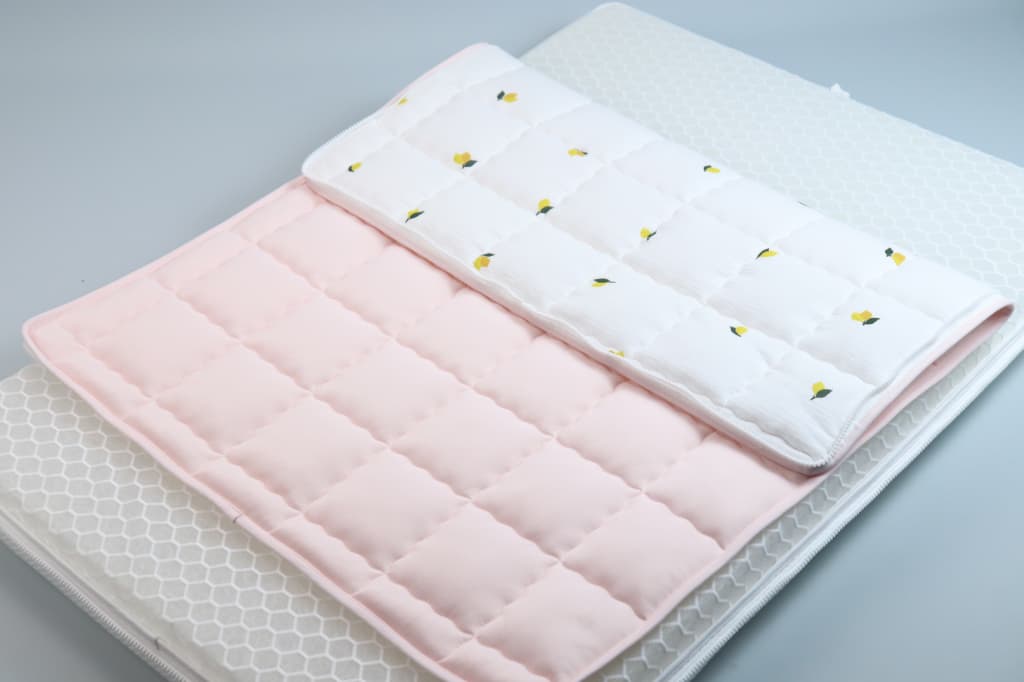
The FBC-1G uses a different construction. It combines a POE Air Fiber core, a removable spacer mesh inner sleeve and a quilted outer cover with two distinct sleeping surfaces.
One side uses EverCool Nylon for a smooth, slightly cool touch. The opposite side uses Crepe Cotton for a softer, warmer feel. The quilted layer contains Dacron™ air-thru polyfill.
A removable 360-degree zipper connects the reversible quilted layer to the mattress construction. This allows the user to detach and reverse the quilted component to select the preferred sleeping surface.
It also allows the relevant quilted layer to be removed for cleaning without necessarily washing the complete cover assembly.
The FBC-1G specification also describes using a three-sided U-shaped zipper for larger mattress sizes to make cover removal easier.
These are two different zipper functions: the 360-degree zipper supports removal and reversal of the quilted layer, while a wider U-shaped opening can support easier removal of the larger mattress cover.
The documented reference size is 71 × 132 × 10 cm, with additional sizes available for customization.
For more information about the material inside these mattresses, read our guide to POE Air Fiber for mattress brands.
What These Two Designs Demonstrate
The FBC-1M shows how a wider opening can improve access to the mattress core. The FBC-1G shows how a perimeter zipper can add a separate function by connecting a removable, reversible quilted layer. These functions can be considered independently during OEM mattress development.
7|OEM/ODM Mattress Cover Sampling Checklist
Before confirming mass production, buyers should evaluate the complete zipper construction using the actual mattress materials and dimensions.
| Development Item | What to Confirm |
|---|---|
| Mattress dimensions | Length, width, core thickness and finished cover dimensions |
| Core material | Material type, flexibility, stiffness and handling requirements |
| Zipper path | L-shaped, U-shaped or perimeter construction, with a clear drawing |
| Zipper components | Zipper type, size, slider arrangement, ends and puller protection |
| Fabric construction | Knitted ticking, quilting, spacer mesh, binding and seam allowances |
| Removal and reinstallation | Ease of handling the real core through the finished opening |
| Sewing quality | Corner operation, seam alignment, puckering and zipper movement |
| Cleaning requirements | Approved washing method, post-wash dimensions and cover fit |
| Target market | Intended user group, safety requirements and required testing |
A physical removal and reinstallation trial is especially valuable. It helps identify whether the zipper opening works as intended before the design is approved for production.
Where zipper performance or finished-product safety testing is required, the appropriate methods should be selected according to the product and destination market. ASTM International provides technical standards resources, while the U.S. Consumer Product Safety Commission provides regulatory information relevant to consumer products sold in the United States.
For information about Mefiss customization, sampling and testing arrangements, visit our manufacturing and product development FAQ.
8|Frequently Asked Questions
8.1|Is a U-Shaped Zipper Always Better Than an L-Shaped Zipper?
No. A U-shaped zipper provides a wider opening, but an L-shaped design may be sufficient for a smaller or more flexible mattress. The appropriate choice depends on the complete product construction and should be confirmed through sampling.
8.2|Does a King-Size Mattress Always Need a 360-Degree Zipper?
Not necessarily. Large mattresses benefit from adequate access, but a three-sided U-shaped opening may be sufficient for some designs. A perimeter zipper should be selected when its specific opening or detachable-panel function is needed.
8.3|Can a Mattress Cover with an L-Shaped Zipper Be Completely Removed?
Yes, depending on the cover construction. An L-shaped zipper can be used on a fully removable cover. Its smaller opening may simply make removal and reinstallation more difficult for certain mattress sizes or cores.
8.4|Are Nylon Coil Zippers Suitable for Spacer Mesh Mattress Covers?
Nylon coil zippers may be suitable because of their flexibility, but the correct specification depends on fabric thickness, seam construction and intended use. The zipper should be evaluated with the actual spacer mesh and cover materials.
8.5|Does a 360-Degree Zipper Make a Mattress Allergen-Proof or Fire-Resistant?
No. These properties depend on the finished mattress or encasement construction and applicable performance requirements. A zipper configuration alone does not establish allergen-barrier performance or regulatory compliance.
8.6|Can the Zipper Construction Be Customized for an OEM Mattress Project?
Yes. Buyers can discuss different opening paths, zipper types, puller arrangements and removable components according to their product requirements. The final construction should be confirmed with an approved sample.
9|Conclusion: Design the Zipper Around the Mattress
There is no single zipper construction that is best for every removable mattress cover.
An L-shaped zipper may provide a simple and practical opening for a compact mattress. A U-shaped zipper can make larger or firmer cores easier to handle. A 360-degree zipper can support detachable quilted panels or other removable components when the construction requires perimeter access.
For brands developing custom mattresses, the most important decision is not simply how long the zipper should be. It is how the complete mattress will be assembled, removed, cleaned and reinstalled.
Mefiss Hometex supports OEM and ODM mattress development involving POE Air Fiber, spacer mesh, quilted fabrics and customized removable cover constructions. By reviewing the core, fabric and zipper design together, buyers can identify practical solutions before mass production.
Developing a Custom Removable Mattress Cover?
Share your mattress dimensions, core material, cover fabrics, preferred zipper opening, target market and estimated order quantity.
Our team can help review the construction and discuss suitable sampling options for your OEM or ODM mattress project.