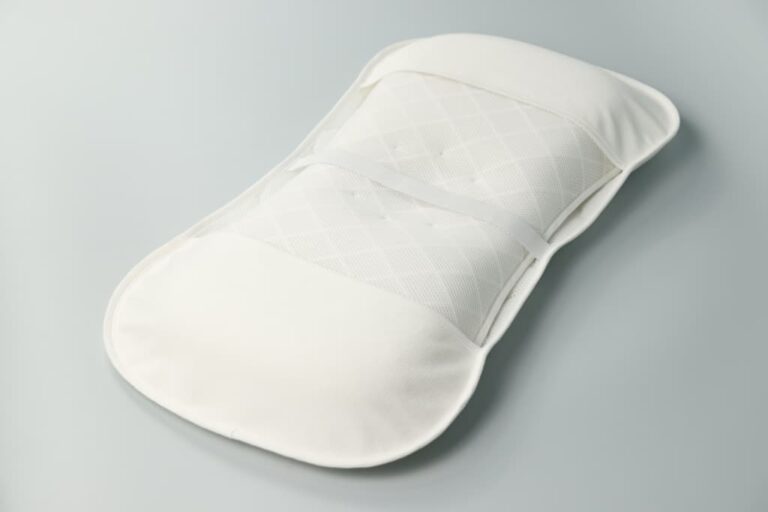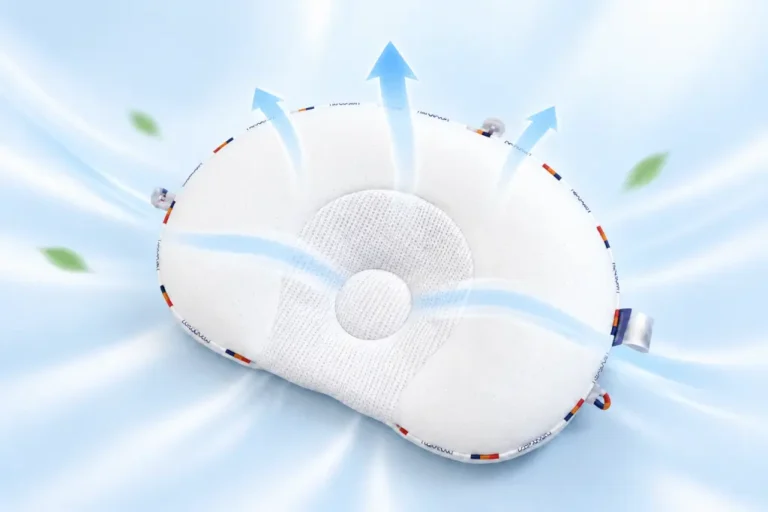

When developing a breathable baby mattress, it is easy to focus on one question:
“Which material has the best airflow?”
That is not enough.
A baby mattress is a complete system. The core, sleeping surface, side panels, comfort layers, waterproofing and cover structure all affect the finished product.
A highly breathable core can lose much of its airflow when covered by dense fabrics. A very open surface can still feel uncomfortable if the support underneath is too hard. A soft comfort layer can also change the firmness of the finished mattress.
After developing different baby and kids mattress structures, we have learned one important lesson:
Do not choose one “breathable material.” Design a breathable mattress structure.
For B2B brands, material selection should balance:
- support;
- airflow;
- surface comfort;
- washability;
- moisture management;
- durability;
- target-market requirements;
- product cost.
This guide explains how we approach those decisions.
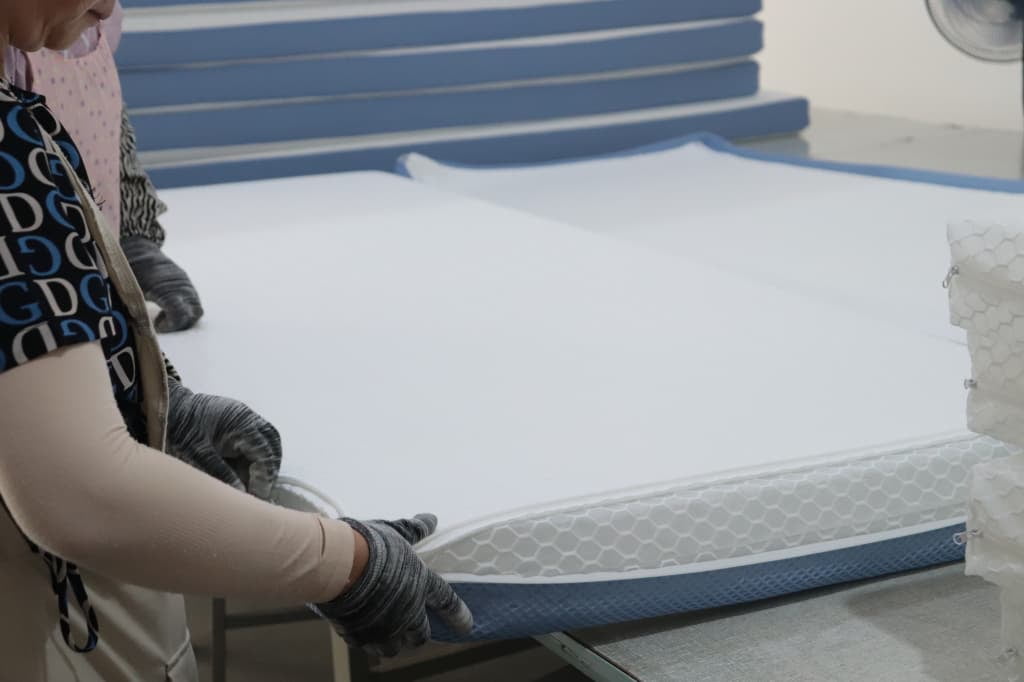
Start With Firmness and Product Structure, Not Airflow
Breathability is important, but it should not be the only design target.
For a baby mattress, the complete product must first have appropriate support and dimensions for its intended use.
The core should not simply be made softer because a brand wants the mattress to feel more comfortable.
The sleeping surface should also not become excessively padded just to create a plush retail feel.
For U.S. crib mattress projects, brands should review the applicable requirements directly with the U.S. Consumer Product Safety Commission before finalizing the structure.
Airflow does not replace firmness, dimensional fit or regulatory compliance.
Mefiss Insight
This changes the way we select materials.
Instead of asking:
“What is the most breathable material?”
we normally ask:
“How can we maintain the required support while allowing more heat and moisture to move through the mattress?”
That leads to much better product decisions.
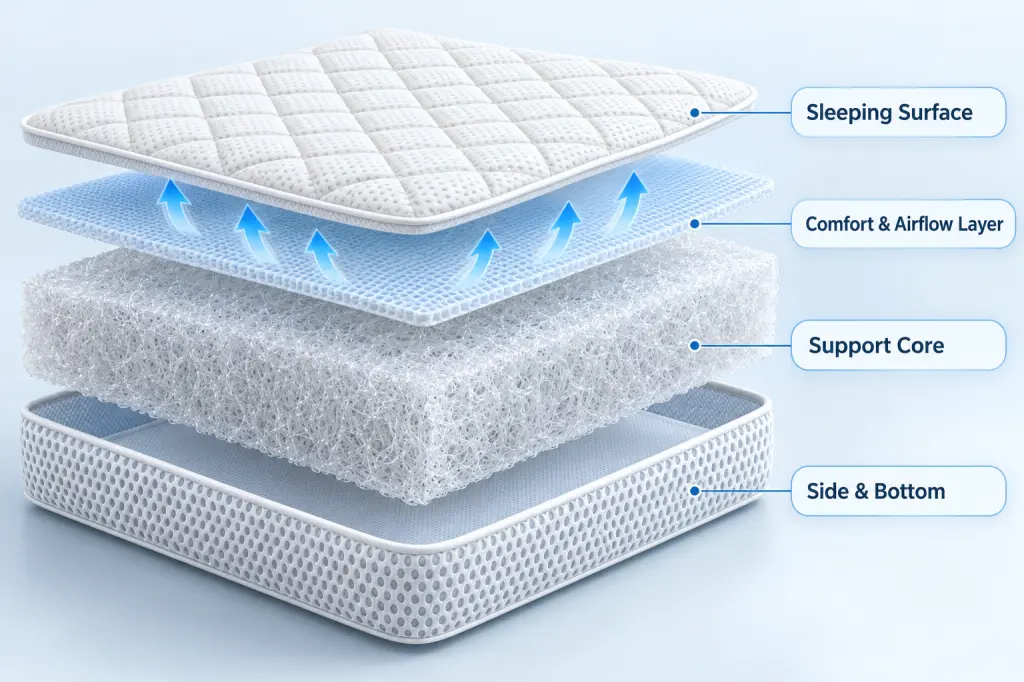
Think of a Baby Mattress as Four Functional Layers
A practical way to develop the product is to divide it into four functions.
1. Sleeping Surface
This is the layer closest to the baby.
It influences:
- touch;
- moisture management;
- surface temperature;
- comfort;
- cleaning.
2. Comfort and Airflow Layer
This can use:
- spacer mesh;
- 3D mesh;
- thin silicone foam;
- breathable quilting.
Its role is to add surface comfort without completely blocking airflow.
3. Main Support Core
This determines most of the mattress support.
Common options include:
- POE air fiber;
- foam;
- latex;
- thick 3D mesh;
- hybrid structures.
4. Side and Bottom Construction
These areas are often ignored.
But if the top is breathable and the sides are completely closed, air and moisture have fewer paths to escape.
For this reason, spacer mesh can also be useful on the sides or bottom of the mattress.
Material 1: POE Air Fiber for the Main Mattress Core
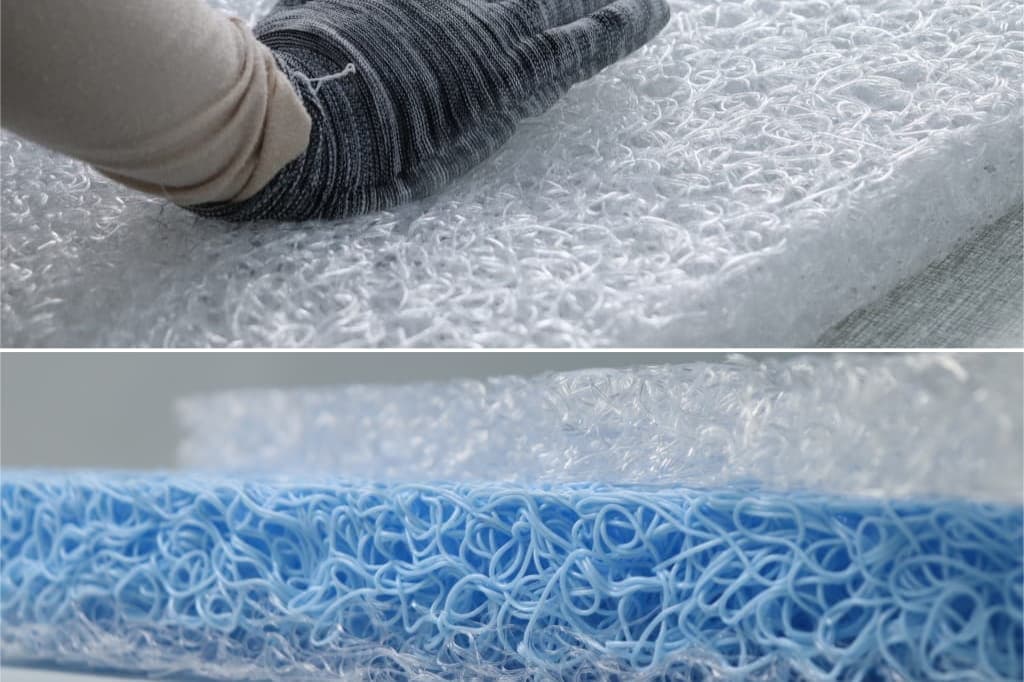
POE air fiber is one of the core materials we often consider when the product requires both airflow and direct cleaning.
Its three-dimensional structure contains large open spaces between connected fibers.
This allows:
- air to move through the core;
- water to drain;
- heat and moisture to escape;
- the core to be rinsed directly;
- consumers to see the inside of the material.
These characteristics make POE useful for washable baby and kids mattresses.
However, POE should not be selected by density alone.
Thickness, fiber diameter, material formulation and internal structure can all change the firmness.
For example, a thinner high-density core can feel harder than a thicker core with a similar density.
Where POE Works Well
POE is especially useful when the brand wants:
- a washable core;
- visible cleanliness;
- high airflow;
- quick drainage;
- stable elastic support;
- dual-firmness options.
Where POE Is Weaker
POE normally does not provide the same soft, body-wrapping comfort as foam.
It can also cost more and cannot usually be vacuum compressed as aggressively as conventional foam.
That means the sleeping surface often needs additional development.
Material 2: Spacer Mesh and 3D Mesh
Spacer mesh is one of the most useful materials for maintaining airflow through the finished mattress.
Unlike a flat fabric, spacer mesh has thickness.
Two fabric surfaces are connected by many internal yarns, creating a three-dimensional structure.
Depending on the design, it can provide:
- airflow;
- resilient cushioning;
- moisture transfer;
- quick drying;
- washable performance.
Where We Use Spacer Mesh
It can be used for:
- sleeping surfaces;
- mattress side panels;
- bottom panels;
- inner core covers;
- comfort layers.
A thicker 3D mesh can also provide meaningful cushioning.
Why Not Use 3D Mesh as the Entire Core?
It is possible.
But a very thick 3D mesh mattress core may require several layers.
For example, a 6 cm core could require multiple 2 cm mesh layers.
Those layers then need to be sewn, fixed or otherwise assembled.
This increases:
- material cost;
- cutting loss;
- labor;
- production complexity.
For many projects, a combination of POE core + spacer mesh surface is therefore more practical.
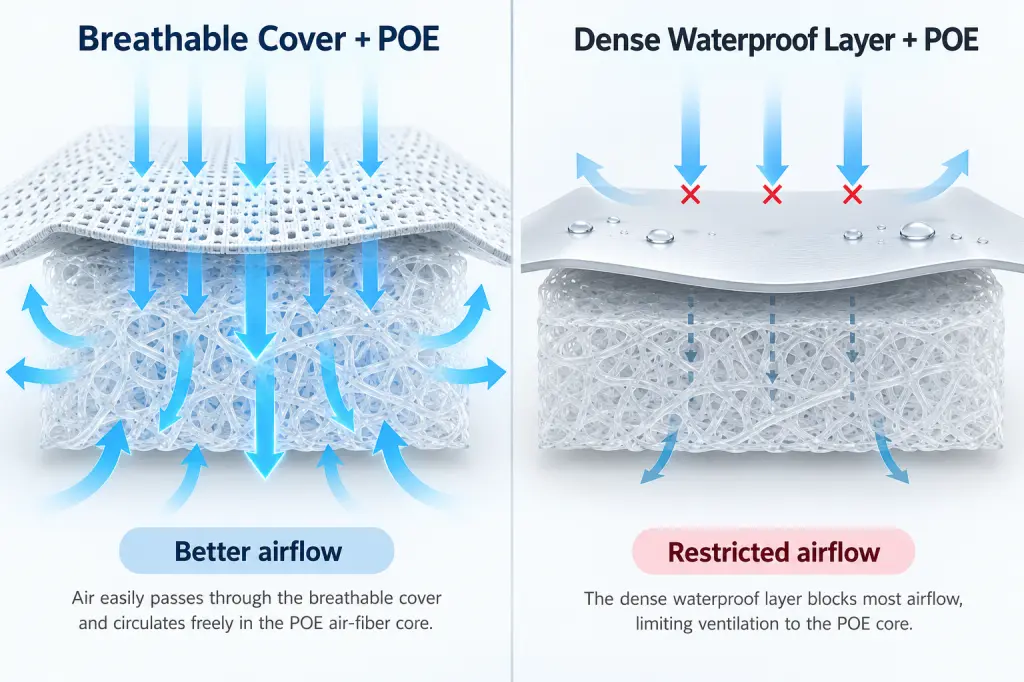
Mefiss Insight: The Cover Can Destroy the Core’s Advantage
This is one of the most common problems we see.
A customer chooses a highly breathable POE core.
Then the mattress is covered with:
- dense fabric;
- thick waterproof lamination;
- low-airflow quilting;
- heavy PU membrane.
The final mattress is much less breathable than expected.
The airflow of the finished mattress is limited by the layers surrounding the core.
This is why we often use spacer mesh around POE air fiber.
The two materials work together rather than competing with each other.
Mefiss Textile, our own warp-knitted fabric factory, produces the spacer mesh and 3D mesh used in many of these mattress projects, so we can adjust the fabric structure together with the finished mattress design.
Material 3: Silicone Foam as a Comfort Layer
Silicone foam can be useful when a mattress needs additional surface softness without using a thick conventional foam layer.
In one of our baby mattress constructions, we use a 5 mm silicone foam sheet underneath a Lyocell sleeping surface.
The role of this layer is not to become the main support core.
Instead, it provides:
- softer surface cushioning;
- resilience;
- airflow through an open-cell structure;
- a different sleeping feel from the firmer mesh side.
This is an important distinction.
A Thin Comfort Layer Can Do More Than a Softer Core
If the main core provides the required support, we often prefer to improve comfort through the surface layers rather than making the entire core softer.
This helps separate two functions:
Core = support
Surface layers = comfort
That gives product developers more control.
Material 4: Lyocell and Other Skin-Contact Fabrics
A breathable core is only one part of the mattress.
The fabric closest to the baby also matters.
Lyocell is often selected because it can provide:
- a soft surface;
- moisture management;
- a smooth hand feel;
- premium positioning.
But no fabric should be selected simply because its fiber name sounds premium.
A thick construction, dense backing or heavy lamination can still reduce airflow.
When choosing the sleeping surface, evaluate:
- fabric structure;
- weight;
- backing;
- stretch;
- moisture transfer;
- drying;
- quilting.
The complete construction matters more than the fiber name alone.
Real Product Example: FBC-1G Dual Firmness Washable Bedside Crib Mattress
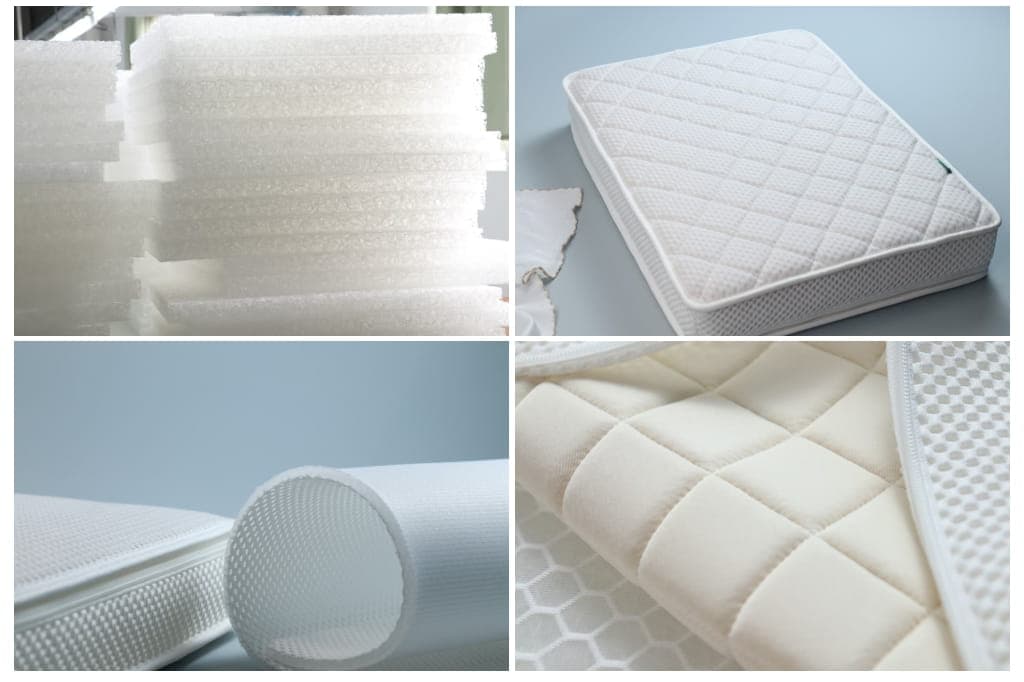
One useful example is our FBC-1G Dual Firmness Washable Bedside Crib Mattress.
The structure uses different materials for different functions.
Main Support Core
The mattress uses a 4 cm, 50D POE air fiber core.
The transparent open structure provides stable support while allowing direct rinsing and airflow.
Softer Comfort Side
One side combines:
- 30% Lyocell ticking;
- 5 mm silicone foam;
- stretch knitted backing.
This creates a softer surface while maintaining moisture transfer and resilience.
More Ventilated Side
The reverse uses 7 mm 3D mesh.
This creates a firmer, more open and more ventilated sleeping surface.
The two sides therefore provide different product experiences without requiring two separate mattresses.
Why This Product Does Not Use the Same Material on Both Sides
It would be simpler to use one fabric on the entire mattress.
But that would remove much of the product differentiation.
The softer side is designed around:
comfort + moisture management
The 3D mesh side is designed around:
airflow + firmer support
The POE core provides:
washability + structural support
This is a good example of system-based material selection.
No single material is expected to do everything.
Should a Baby Mattress Be Fully Waterproof?
This requires careful consideration.
Waterproofing is useful because accidents happen.
But maximum waterproofing can conflict with maximum airflow.
A heavy waterproof membrane may become the main airflow barrier in the mattress.
One solution is to separate the functions.
For example:
Breathable mattress
Removable waterproof fitted protector
This allows the waterproof component to be washed or replaced separately.
Another solution is to make one mattress panel detachable for easier cleaning.
The correct approach depends on the intended product and market.
Breathability and Safety Should Not Be Confused
This point is especially important in baby product marketing.
A mattress can have a highly breathable material structure.
That does not mean a brand should automatically make broad claims such as:
“prevents suffocation”
or
“safe because it is breathable.”
Breathability is one material performance characteristic.
Finished-product safety also depends on factors such as:
- firmness;
- product dimensions;
- fit;
- construction;
- labeling;
- applicable market standards.
For U.S. crib mattress projects, brands should review current CPSC crib mattress requirements before development is finalized.
What About Memory Foam?
Memory foam has excellent contouring and a soft, familiar sleeping feel.
But it is not usually our first choice when direct core washing and maximum airflow are the main product goals.
Its advantages include:
- soft comfort;
- pressure distribution;
- easy contour shaping;
- vacuum compression.
Its limitations for a breathable washable baby mattress can include:
- slower drying;
- limited direct washing;
- lower airflow than an open POE core;
- greater heat retention depending on construction.
That does not make memory foam a bad material.
It simply solves a different design problem.
(read the POE Air Fiber vs Memory Foam )
What About Latex?
Latex can provide very even support and good elasticity.
Compared with POE, it may offer a more comfortable and familiar sleeping feel.
However, for projects focused on:
- direct rinsing;
- fast drying;
- visible internal cleanliness;
- very open airflow;
POE may be easier to design around.
Again, the choice depends on the product brief.
A Hybrid Mattress Can Be More Practical
A mattress does not need to use only one material.
For some projects, hybrid construction can create a better balance between:
- cost;
- comfort;
- support;
- airflow.
For example:
5 cm POE Air Fiber + 3 cm Foam
can create two different sleeping experiences.
Another option is:
POE Air Fiber + thick 3D Mesh
where the POE provides support and the 3D mesh improves the surface feel.
Mefiss Insight
The most expensive material used at maximum thickness is not always the best design.
A good B2B product should balance performance with commercial reality.
How to Evaluate a Breathable Baby Mattress Material
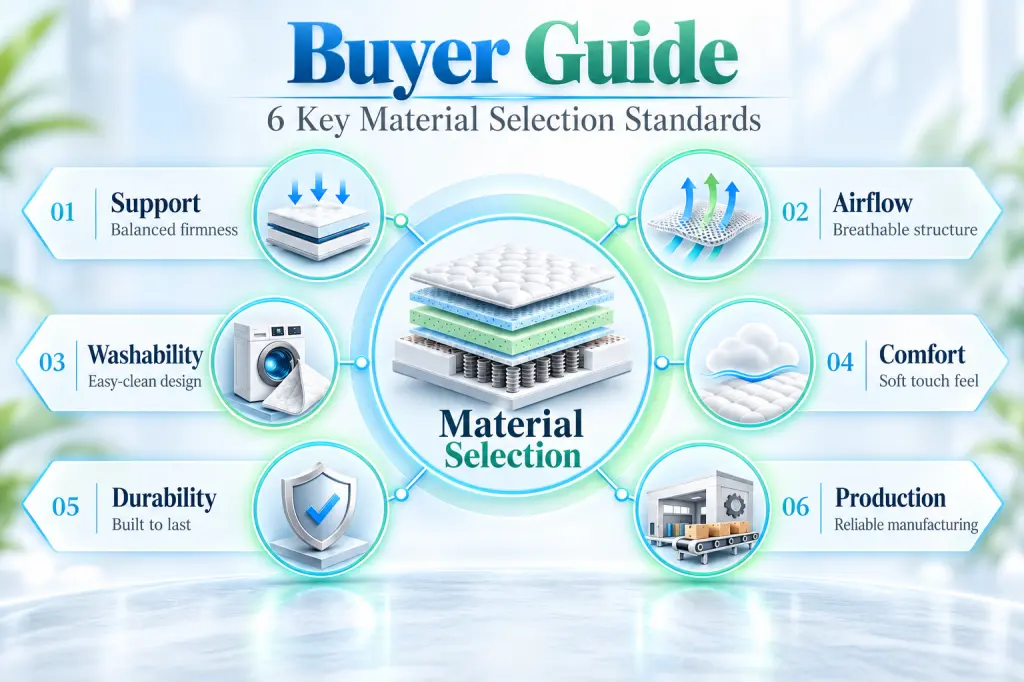
When comparing materials, we suggest evaluating six areas.
1. Support
Does the material provide the firmness required for the product?
2. Airflow
Can air move through the material itself?
And can it still move through the complete mattress?
3. Washability
Can the cover be washed?
Can the core be rinsed?
How will both parts dry?
4. Surface Comfort
Does the user contact a hard core directly, or is there an appropriate comfort layer?
5. Durability
Does the material recover after repeated pressure and washing?
6. Production Practicality
Can the material be:
- cut consistently;
- sewn or covered efficiently;
- shipped economically;
- produced at the required MOQ?
These commercial questions are just as important as laboratory performance.
What Should a Brand Send to the Manufacturer?
A clear product brief helps avoid unnecessary sample revisions.
At minimum, provide:
- Mattress size
- Target age group
- Required total thickness
- Preferred firmness
- Target market
- Washing requirement
- Waterproof requirement
- Cover material preference
- Target retail positioning
- Estimated order quantity
- Packaging method
- Required testing
If you are unsure about the material, describe the product goal instead.
For example:
“We need a washable 70 × 120 cm baby mattress with a firmer summer side and a softer comfort side.”
That is often more useful than simply requesting:
“50D POE.”
FAQ
What is the most breathable baby mattress material?
There is no single answer. POE air fiber and 3D mesh can both provide very open structures, but the finished mattress also depends on the surface fabric, side panels and other layers.
Is POE Air Fiber suitable for baby mattresses?
It can be useful when the project needs a washable, open and resilient core. The final density, thickness, firmness and complete mattress construction must still be selected for the specific product.
Why use spacer mesh over POE if POE is already breathable?
Spacer mesh helps keep the outer mattress structure open while also adding resilient surface cushioning and moisture transfer.
Is a waterproof baby mattress still breathable?
That depends on the waterproof construction. A dense waterproof membrane can significantly reduce airflow, so waterproofing and breathability should be evaluated together.
Can silicone foam be used as the full mattress core?
It can be used in different constructions, but in our current baby mattress example we use a thin silicone foam layer mainly to improve surface comfort rather than as the main support core.
Can different materials be used on the two sides?
Yes. Dual-sided construction is useful when a brand wants different firmness, comfort or seasonal experiences from one mattress.
Final Thoughts
Choosing materials for a breathable baby mattress is not a competition to find the material with the biggest air holes.
The product needs to work as a complete system.
A practical structure may combine:
- soft skin-contact fabric
- breathable comfort layer
- supportive washable core
- open side and bottom construction
The main lesson from our mattress development work is simple:
Support, airflow and comfort should be designed separately, then brought together in one mattress.
POE air fiber can provide washable support.
Spacer mesh can preserve airflow and improve cushioning.
Silicone foam can add surface softness.
Lyocell and other selected fabrics can improve skin-contact comfort and moisture management.
The best result comes when each material has a clear job.
Developing a Breathable Baby Mattress?
Mefiss supports OEM and ODM development for baby and kids mattresses.
We can help develop:
- POE air fiber cores;
- spacer mesh and 3D mesh structures;
- dual-sided mattress covers;
- silicone foam comfort layers;
- quilted surfaces;
- washable constructions;
- different firmness levels;
- customized dimensions and packaging.
Send us your target mattress size, age group, preferred firmness, washing requirement and target market. We can recommend a practical starting structure for sampling.