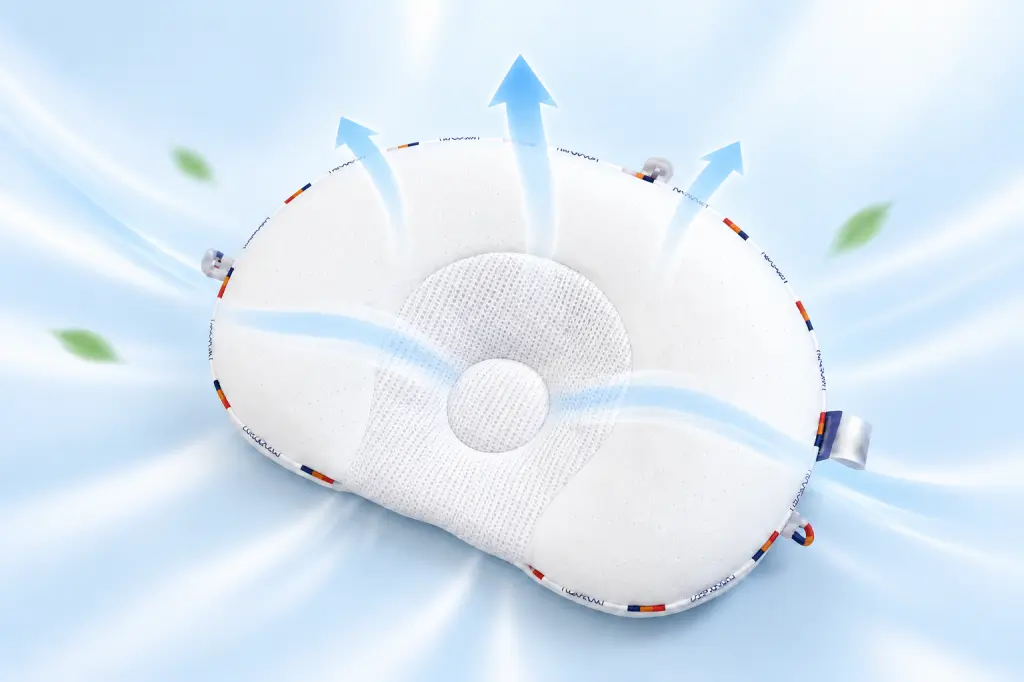
“Breathable” is one of the most common words used in baby pillow development.
But adding mesh fabric or making a few ventilation holes does not automatically create a well-designed breathable product.
A baby pillow is a complete system.
The sleeping surface, inner support layer, filling or core, cover construction, washability and product shape all affect how the finished pillow performs.
For brands developing baby products, there is another important factor:
The target market and intended use must be defined before the pillow structure is finalized.
This is especially important for products intended for infants.
Our product development experience has shown that the best approach is not to ask:
“Which material is the most breathable?”
A better question is:
“What does each layer need to do, and how can we maintain airflow without losing comfort, support or cleanability?”
First: Define the Target Age, Market and Intended Use
Before selecting fabrics or fillings, define:
- target age;
- target country;
- intended use;
- where the product will be used;
- whether it is intended for sleep, positioning, nursing or another purpose;
- required product testing.
This matters because baby pillow regulations and safe-sleep recommendations vary by product type and market.
For example, the U.S. Consumer Product Safety Commission recommends keeping pillows and other soft objects out of an infant sleep space and provides specific guidance for infant sleep products.
For brands selling into the United States, product design and marketing language should therefore be reviewed against the intended product category before launch.
See the CPSC Safe Sleep Guidance for current U.S. guidance.
A breathable material should never be used as a shortcut to make broad claims such as:
“prevents suffocation”
or
“safe for unsupervised infant sleep.”
Breathability is a material characteristic. It does not replace product safety requirements.
Think of a Baby Pillow as Four Functional Parts
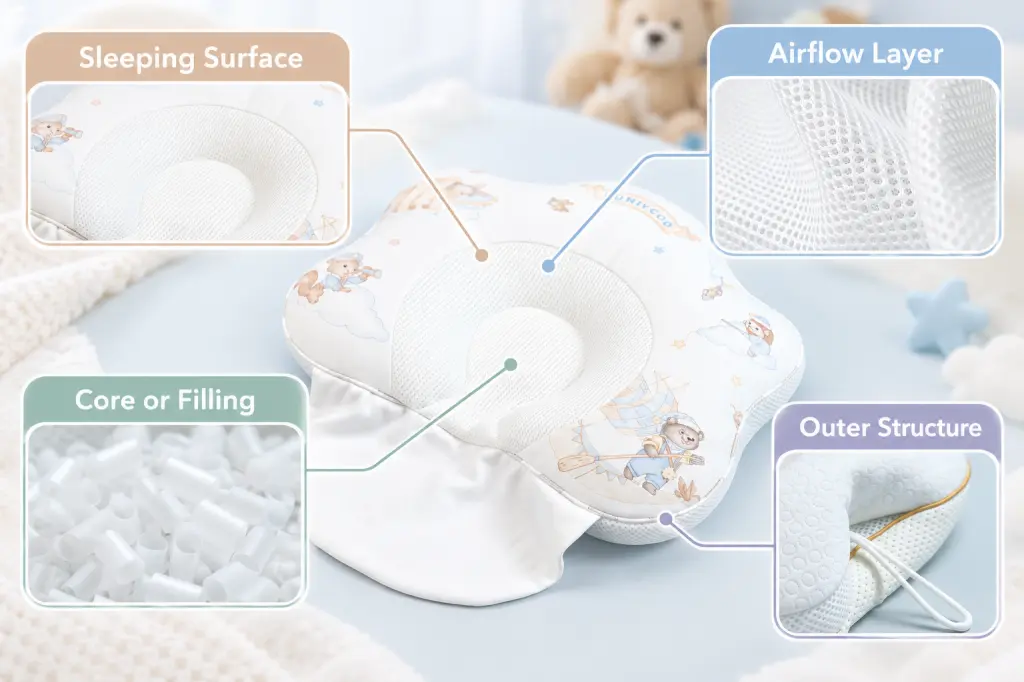
A practical way to develop the product is to divide it into four areas.
1. Sleeping Surface
This is the fabric closest to the skin.
It affects:
- touch;
- moisture management;
- cooling sensation;
- friction;
- cleaning.
2. Airflow Layer
This may use:
- spacer mesh;
- 3D mesh;
- open-cell foam;
- perforated structures.
Its job is to create space for air and moisture movement.
3. Support Core or Filling
This controls most of the pillow’s:
- height;
- rebound;
- firmness;
- shape;
- adjustability.
4. Outer Structure
This includes:
- seams;
- adjustment areas;
- zippers;
- removable covers;
- edge construction.
Even when every individual material is breathable, a poor overall construction can restrict airflow.
Material Route 1: Open-Cell Silicone Foam
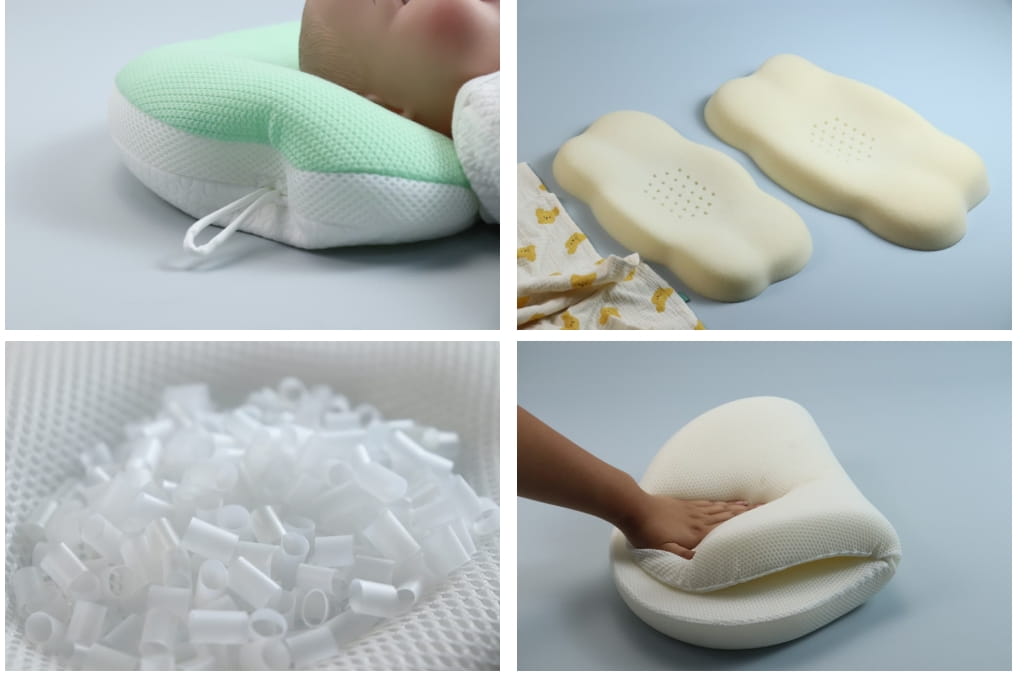
One way to develop a washable and ventilated pillow is to use a highly open silicone foam core.
Unlike a conventional solid-feeling foam block, the silicone foam used in some of our baby pillow projects has an open-cell structure.
This helps create:
- airflow through the core;
- quick moisture release;
- resilient support;
- direct washing;
- faster drying.
The main advantage is that one material can provide both shape and support.
This is useful when the product needs a defined contour.
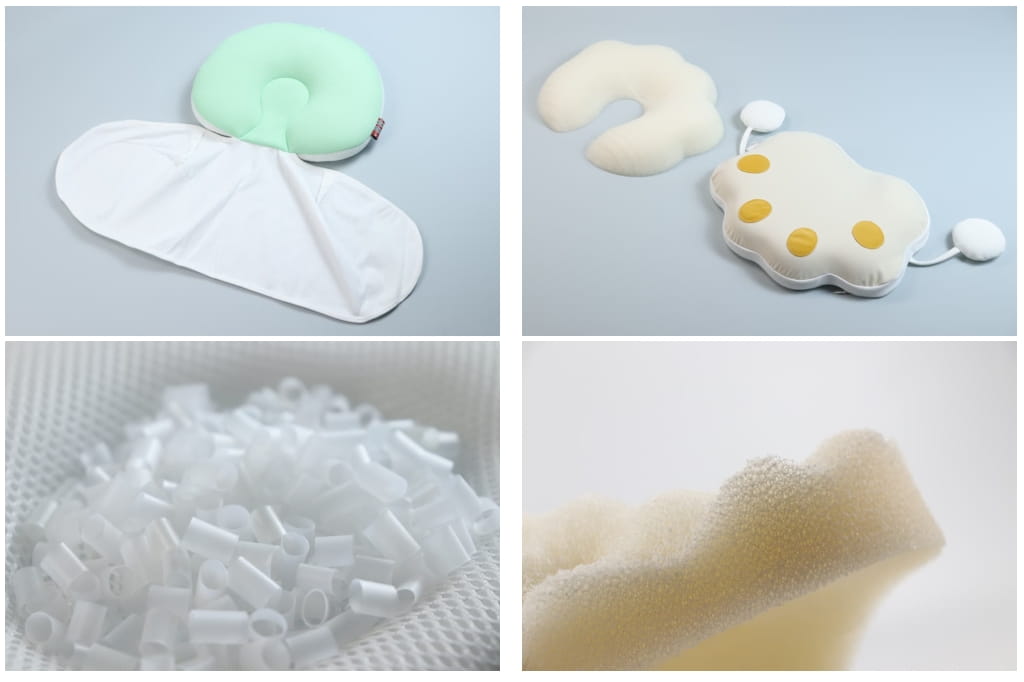
Real Product Example 1: Silicone Foam Baby Head Pillow
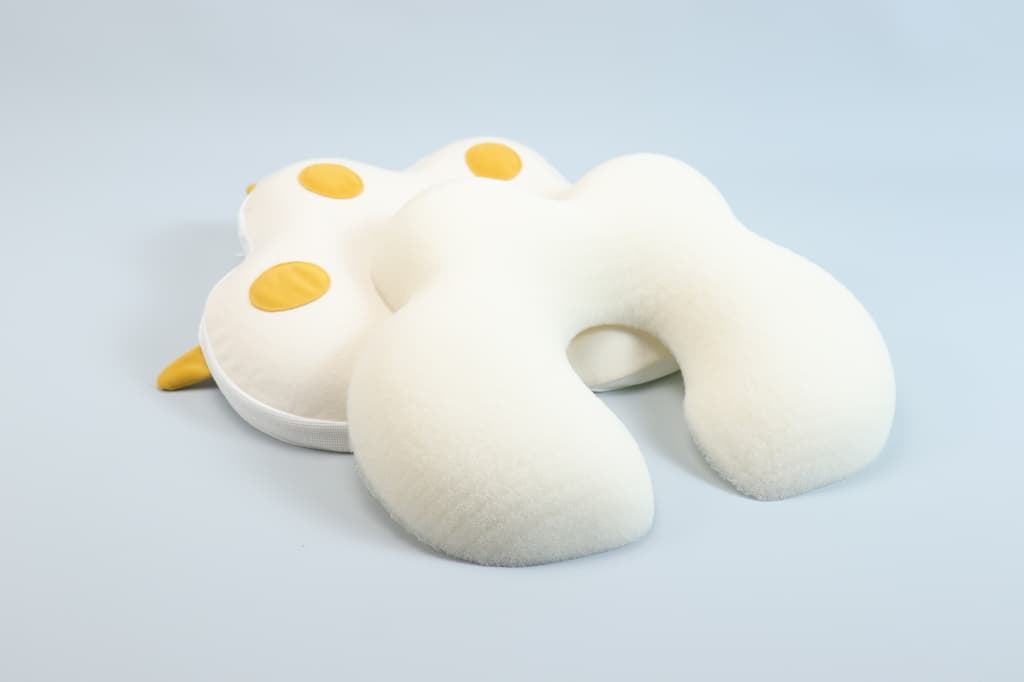
One example is our Silicone Foam Baby Head Pillow.
The product combines:
- an open-cell silicone foam core;
- a cooling nylon sleeping surface;
- removable side support pads;
- an embroidered cat-paw appearance.
The silicone foam core has an open-cell ratio above 90% according to the product specification.
This gives the material a very different internal structure from conventional memory foam.
The core is designed to be directly washable and quick drying.
Why Use Silicone Foam Instead of Memory Foam?
Memory foam provides excellent contouring.
But for this product, the development priorities were different:
airflow + washability + structural stability
The silicone foam core allows the pillow shape to remain defined without using loose filling.
It also makes the internal structure easier to clean.
Breathability Should Continue Through the Cover
A breathable core can still perform poorly if it is wrapped in the wrong fabric.
For this product, the sleeping area uses a cooling nylon fabric with stretch.
This is important because a very rigid cover may compress or close part of the surface structure.
When we develop a cover for an open core, we normally consider:
- fabric density;
- stretch;
- backing;
- lamination;
- moisture transfer;
- washing stability.
Mefiss Insight
A breathable core needs a breathable interface with the user.
A material specification may look excellent in isolation, but the finished product is what the customer actually uses.
Material Route 2: Spacer Mesh + Washable Filling
Another approach is to separate airflow from support.
Instead of asking one material to do everything, the pillow can use:
- Spacer Mesh for airflow
- TPE Tube for adjustable support
This creates a different type of product.
Spacer mesh has two fabric surfaces connected by many internal yarns.
The hollow three-dimensional structure provides space for:
- air movement;
- moisture transfer;
- quick drying;
- resilient cushioning.
TPE tubes can then be used inside the pillow to provide movable support.
Their hollow structure also helps preserve airflow through the filling area.
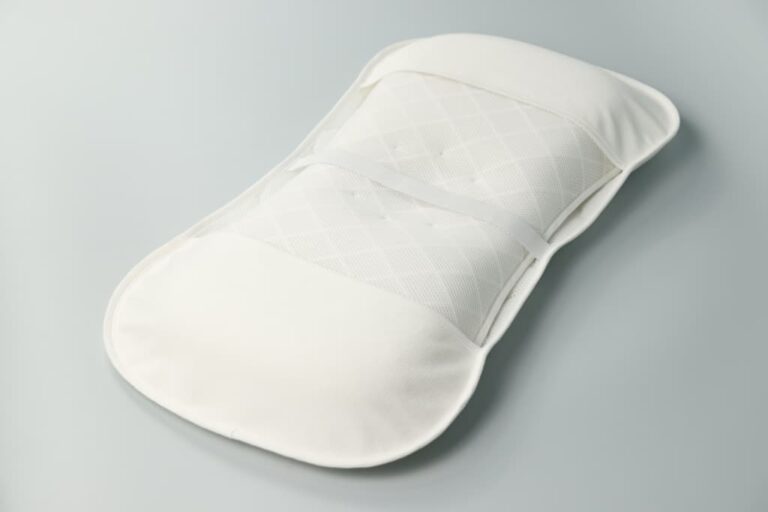
Real Product Example 2: Adjustable Newborn Swaddle Head Shaping Pillow
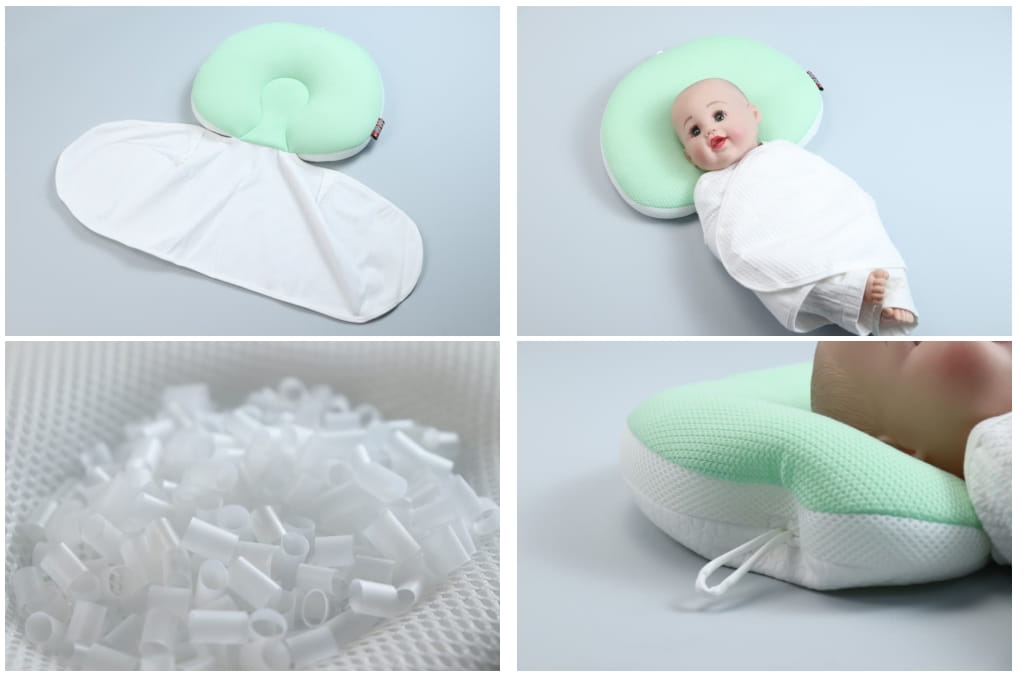
A second example is our Adjustable Newborn Swaddle Head Shaping Pillow.
Its structure includes:
- Mes-tio Shield™ mesh;
- 4 mm spacer mesh;
- hollow TPE tube filling;
- three independently adjustable head-support areas;
- reversible seasonal materials;
- an integrated swaddle structure.
This product takes a very different development approach from the silicone foam pillow.
The silicone foam model uses a:
formed core
This model uses a:
textile airflow layer + movable filling
Why Use Spacer Mesh Under the Surface?
A thin surface fabric alone does not create much internal airflow space.
Adding 4 mm spacer mesh underneath creates a small three-dimensional air layer.
It also adds resilient cushioning.
This is particularly useful when the visible surface fabric needs to provide:
- softer touch;
- color;
- printing;
- antibacterial treatment;
- premium appearance.
The spacer mesh underneath can handle more of the structural airflow function.
Mefiss Textile, our own warp-knitted fabric factory, produces the spacer mesh used in many of these pillow projects.
This allows us to change:
- thickness;
- mesh opening;
- surface yarn;
- hand feel;
- color;
according to the finished pillow design.
Formed Core or Loose Filling: Which Is Better?
There is no single answer.
They solve different product problems.
| Feature | Silicone Foam Core | TPE Tube Filling |
|---|---|---|
| Fixed shape | Strong | Lower |
| Adjustable height | Limited | Strong |
| Airflow | High with open-cell structure | High with hollow tubes |
| Washability | Good | Good |
| Shape consistency | High | Depends on filling distribution |
| Custom contour | Good with tooling | Created through sewn zones |
| User adjustment | Limited | Easy |
| Production complexity | Core tooling | Sewing + filling zones |
A molded or formed core works well when the product needs a stable shape.
Loose filling is more useful when the brand wants:
- adjustable height;
- multiple support zones;
- refillable construction.
Do Not Judge Breathability by Hole Size Alone
This is another common development mistake.
Large visible holes can look very breathable.
But actual airflow depends on more than appearance.
Consider:
- whether the holes pass through the complete layer;
- fabric density;
- internal yarn structure;
- backing materials;
- quilting;
- lamination;
- filling density;
- cover tension.
For example, an open spacer mesh layer can lose much of its advantage if it is laminated to a dense backing.
Similarly, a pillow filled with too much material can become less ventilated even if the filling itself is breathable.
Mefiss Insight
Breathability is a path, not a single material.
Air needs a way to enter, move through and leave the product.
Adjustability Changes the Product Structure
Many baby pillow concepts include adjustable height or support zones.
From a manufacturing point of view, adjustability adds complexity.
The product may need:
- separate filling chambers;
- reinforced seams;
- drawcords;
- zippers;
- filling openings;
- hidden storage areas.
Every added function should be reviewed for:
- durability;
- loose components;
- seam strength;
- usability;
- applicable child-product requirements.
More functions do not automatically make a better product.
A simpler construction can sometimes be more appropriate for the target market.
Product Classification Matters in the United States
For brands selling products for infants in the U.S., it is important to determine whether a product falls within the scope of an infant support cushion or another regulated product category.
The U.S. Consumer Product Safety Commission provides specific business guidance for infant support cushions.
See the CPSC Infant Support Cushions Business Guidance for current requirements.
Product classification should therefore be confirmed based on:
- design;
- intended use;
- marketing;
- age range;
- labeling.
Do not wait until mass production to check this.
What Testing Should a Brand Consider?
There is no single “baby pillow test” that covers every product and market.
Testing should be selected according to the product construction and destination market.
Chemical and Material Testing
Depending on the market and materials:
- restricted substances;
- formaldehyde;
- pH;
- fiber content;
- relevant chemical compliance.
Color and Fabric Performance
For dyed or printed covers:
- color fastness;
- dimensional stability;
- pilling;
- washing shrinkage.
Functional Claims
If the product makes specific claims:
- antibacterial testing;
- anti-mite testing;
- cooling performance;
- air permeability.
Product Construction
Depending on the design:
- seam strength;
- attachment strength;
- zipper durability;
- filling leakage;
- repeated washing;
- shape recovery.
For U.S. children’s products, applicable requirements may also include third-party testing, certification and tracking-label obligations depending on product classification.
Do Not Turn Material Testing Into a Product Safety Claim
This is worth highlighting.
Suppose a spacer mesh has excellent air permeability.
That proves something about the material under a specific test method.
It does not automatically prove:
“This pillow prevents suffocation.”
Similarly, an antibacterial report does not mean:
“This product prevents illness.”
Testing results should be described according to what was actually tested.
This improves both compliance and credibility.
Washability Should Be Designed Into the Whole Pillow
For a washable baby pillow, consider:
- Can the outer cover be removed?
- Can the core or filling be washed?
- How long does it take to dry?
- Will the pillow keep its shape?
- Will the filling move after washing?
- Will adjustment components remain stable?
- Can the user reinstall the cover easily?
Silicone foam and TPE tubes both offer useful washable properties.
But they require different product constructions.
For a formed silicone core, drying and shape recovery are relatively simple.
For loose TPE filling, chamber design becomes more important because the filling should remain evenly distributed after cleaning.
What Information Should a Brand Send to the Manufacturer?
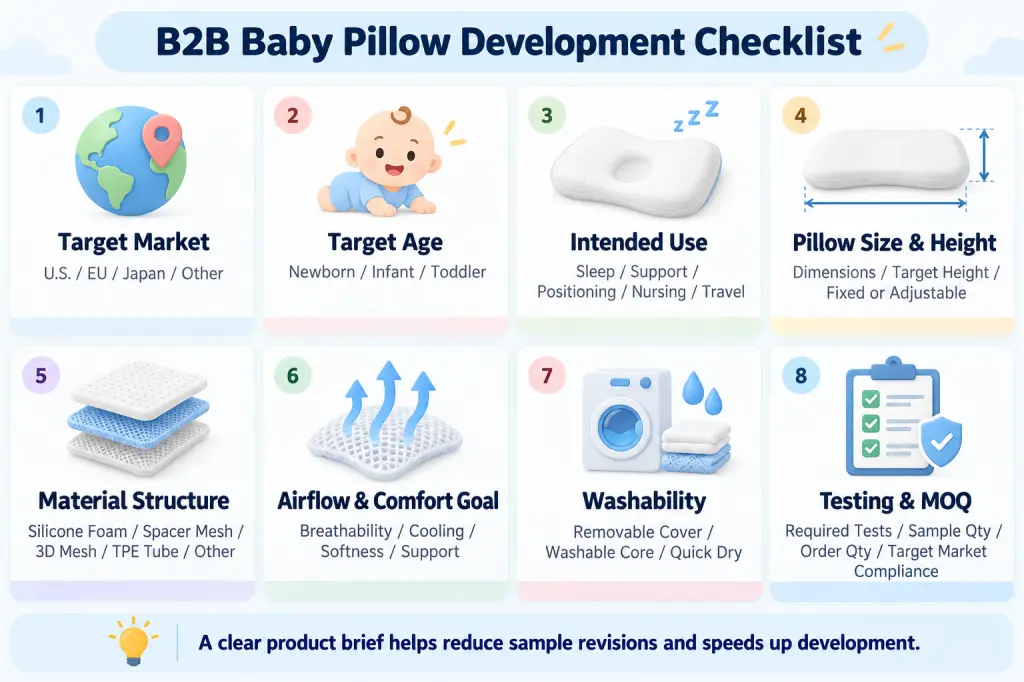
Before requesting a sample, provide at least:
- Target age
- Target country
- Intended use
- Pillow dimensions
- Target height
- Preferred firmness
- Core or filling preference
- Cover fabric requirement
- Washability requirement
- Adjustable or fixed structure
- Required testing
- Estimated order quantity
If you do not know the materials yet, send the product goal instead.
For example:
“We need a washable baby support product with a cool-touch surface, adjustable height and good airflow.”
This gives the manufacturer more room to recommend a suitable construction.
FAQ
What material is best for a breathable baby pillow?
There is no single best material. Open-cell silicone foam, spacer mesh, 3D mesh and hollow TPE filling can all provide airflow in different structures.
Is 3D mesh enough to make a pillow breathable?
Not automatically. The surface fabric, backing, filling and complete construction can still restrict airflow.
Is silicone foam washable?
The silicone foam used in the product example above is designed for direct washing and quick drying. The exact care method should always follow the material specification.
Why use TPE tubes as pillow filling?
Hollow TPE tubes provide movable, washable support and allow filling quantity to be adjusted in zoned pillow constructions.
Can a baby pillow be marketed for infant sleep in the United States?
Brands should not assume this.
CPSC safe-sleep guidance recommends keeping pillows out of an infant sleep space, and some infant pillows or support cushions may fall under specific product regulations depending on their design and intended use.
See CPSC — Pillows for current U.S. guidance.
What should be tested before mass production?
Testing should be selected according to the target market, product classification, materials and claims. Material tests alone should not be treated as proof of complete product safety.
Final Thoughts
Developing a breathable baby pillow is not simply about finding a fabric with large holes.
The complete product needs to balance:
airflow + support + comfort + washability + durability + compliance
The two products in this article show two different development directions.
One uses a formed open-cell silicone foam core.
The other combines spacer mesh with adjustable TPE tube filling.
Neither structure is automatically better.
They are designed for different product concepts.
For B2B brands, the most important step comes before material selection:
Define who will use the product, where it will be sold, and exactly how it is intended to be used.
Once that is clear, material selection becomes much easier.
Developing a Breathable Baby Pillow or Support Product?
Mefiss is a custom pillow manufacturer supporting OEM and ODM development for baby and kids textile products.
We can develop:
- silicone foam cores;
- spacer mesh and 3D mesh structures;
- TPE tube filling;
- cooling fabrics;
- washable covers;
- adjustable zones;
- customized shapes;
- private-label packaging.
For infant products, we also recommend confirming the intended use and destination-market requirements before finalizing the product structure.