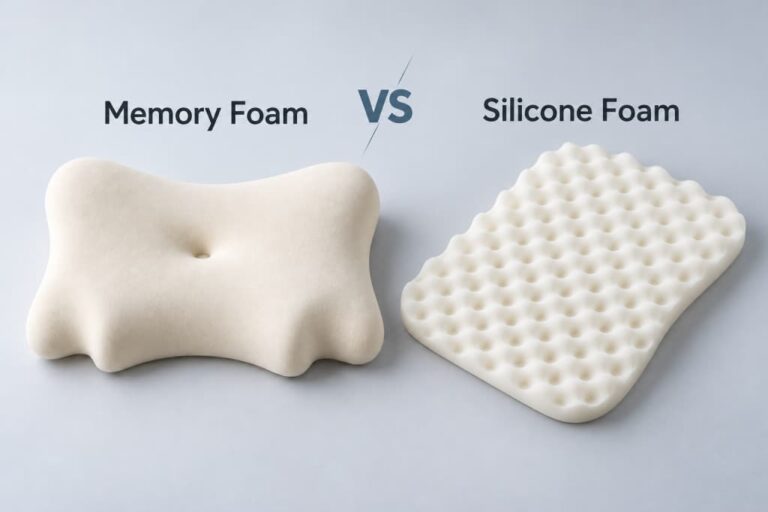
When developing a breathable pillow, brands often compare two very different materials:
and
Both can be used inside a pillow, but they do not provide the same sleeping experience.
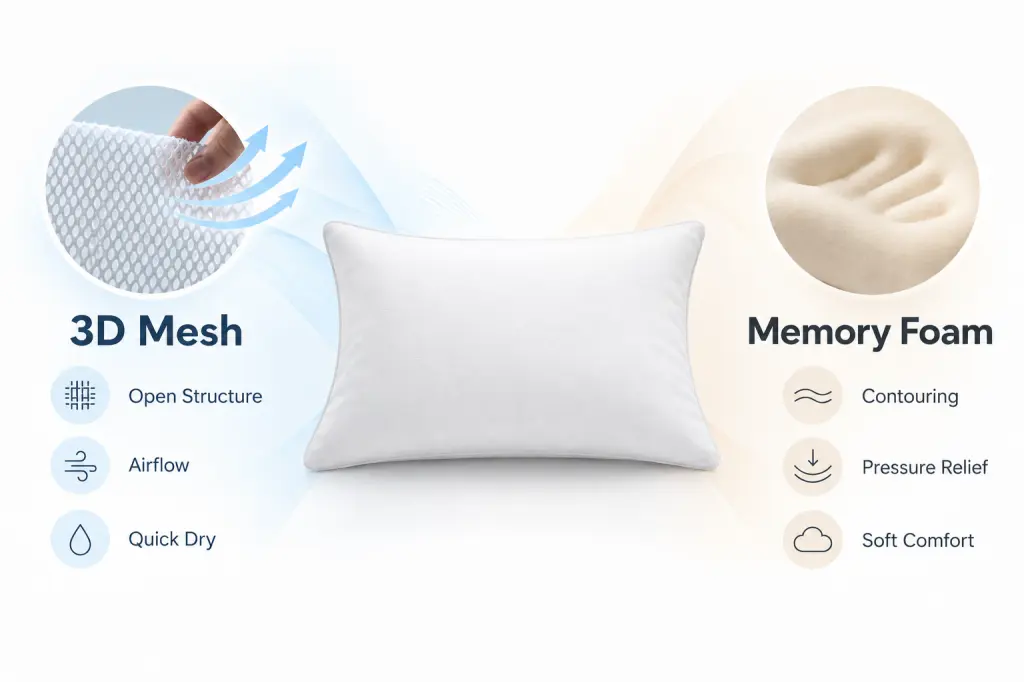
3D mesh focuses on:
- airflow;
- moisture release;
- quick drying;
- elastic rebound.
Memory foam focuses on:
- contouring;
- pressure adaptation;
- soft support;
- a slower, more wrapped sleeping feel.
This means the right question is not:
“Which material is better?”
A better question is:
“Which function should this part of the pillow provide?”
From our product development experience, 3D mesh and memory foam do not always need to compete.
In some pillow structures, using both materials can produce a better balance between comfort, support and airflow.
The Basic Difference: Open Structure vs Foam Structure
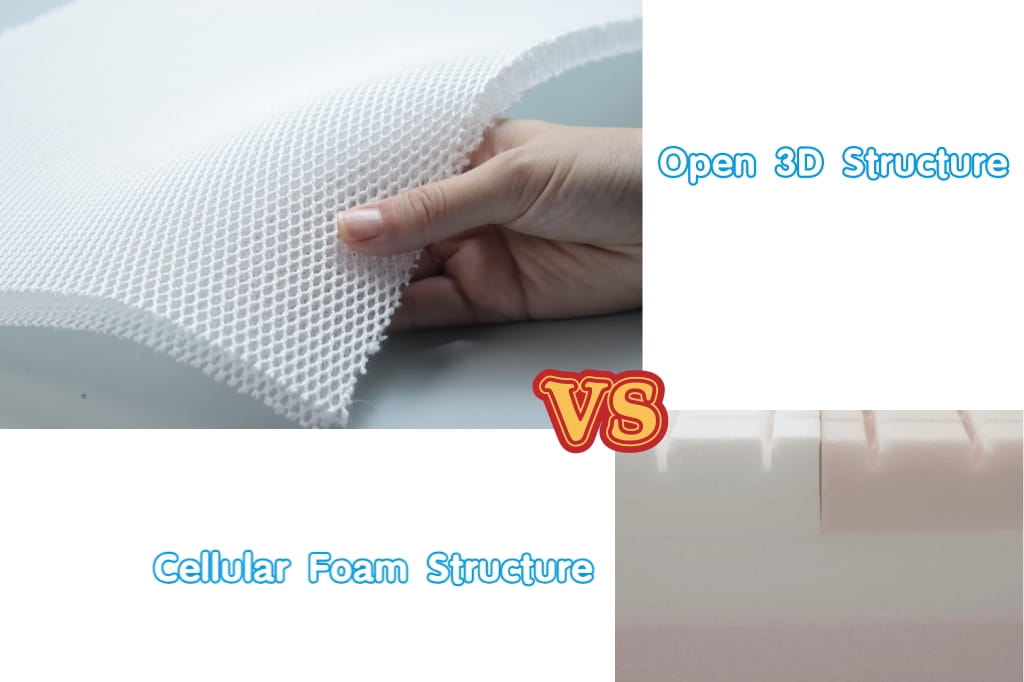
The biggest difference is their internal structure.
3D Mesh
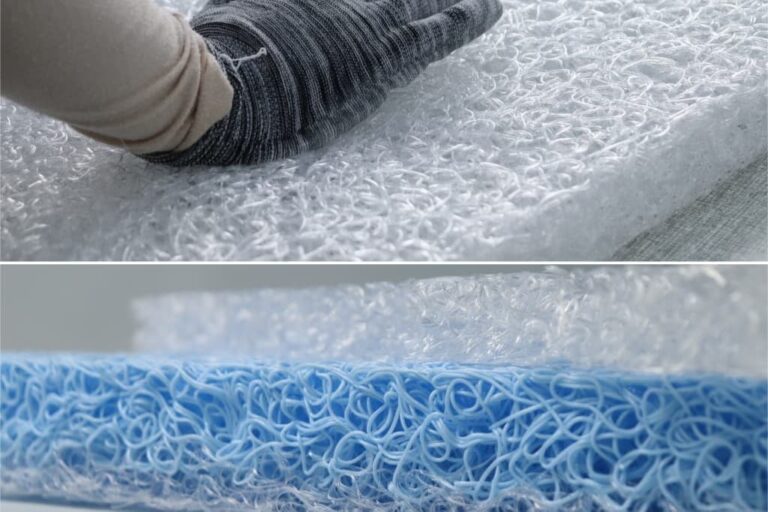
3D mesh is a warp-knitted textile structure.
It normally has:
- a top fabric surface;
- a bottom fabric surface;
- vertical or angled monofilament yarns connecting both sides.
These internal yarns create an open three-dimensional space.
Air and moisture can move through this structure much more easily than through a dense foam block.
Depending on the construction, 3D mesh can also provide spring-like rebound.
Memory Foam
Memory foam is a slow-recovery polyurethane foam.
When pressure is applied, the foam gradually compresses around the body and then slowly returns toward its original shape.
This creates the familiar contouring sensation.
Memory foam is therefore excellent when the goal is:
- adaptive support;
- pressure distribution;
- softer wrapping comfort.
But its internal structure is much denser than 3D mesh.
3D Mesh vs Memory Foam at a Glance
| Feature | 3D Mesh | Memory Foam |
|---|---|---|
| Airflow | Very high | Moderate to low |
| Quick drying | Very good | Slower |
| Direct washing | Usually easier | Usually not recommended |
| Rebound | Springy | Slow recovery |
| Contouring | Limited | Strong |
| Soft wrapping feel | Limited | Strong |
| Height adjustment | Easy with inserts | Easy with cut foam or shredded foam |
| Shape customization | Limited by textile structure | Very flexible |
| Heat release | Strong | Depends on foam structure |
| Moisture release | Strong | Lower |
| Compression packaging | Limited | Very good |
| Best role | Airflow and resilient support | Comfort and contouring |
The table is only a general development reference.
Actual performance depends on thickness, density, yarn structure, foam formulation and the complete pillow construction.
Why 3D Mesh Works Well in Breathable Pillows
The main advantage of 3D mesh is not simply that it has visible holes.
Its real advantage is the three-dimensional space inside the material.
The connecting yarns keep the two fabric surfaces apart.
This creates continuous channels where:
- air can move;
- heat can escape;
- moisture can spread and dry.
A thick 3D mesh layer can also behave like many small springs.
When pressure is released, the monofilament structure helps the fabric return toward its original thickness.
Mefiss Insight
The thickness of 3D mesh creates both airflow space and mechanical rebound.
This is why a 10–12 mm 3D mesh layer feels very different from a thin conventional mesh fabric.
Why Memory Foam Is Still Popular
Memory foam has one major advantage that 3D mesh cannot fully reproduce:
body contouring.
When the head or neck presses into memory foam, the material changes shape around the pressure area.
This can create:
- softer pressure distribution;
- better contact with body curves;
- a deeper comfort feeling.
For many adult pillows, this is still very attractive.
Memory foam is also much easier to cut into complicated shapes.
It can be used for:
- cervical curves;
- shoulder zones;
- recessed head areas;
- contoured ergonomic forms.
3D mesh is more suitable for flatter layers and inserts.
Memory Foam Has Different Grades Too
Not all memory foam performs the same way.
Important variables can include:
- foam density;
- firmness;
- recovery speed;
- cell structure;
- formulation;
- block quality.
Brands should therefore avoid comparing memory foam only by color or appearance.
For general information about flexible polyurethane foam production, the U.S. Environmental Protection Agency provides official industry information.
For general background on polyurethane foam manufacturing, see U.S. EPA — Flexible Polyurethane Foam Production.
Airflow: 3D Mesh Has the Clear Advantage
If airflow is the main priority, 3D mesh normally has a structural advantage.
Large internal spaces allow air to pass through the material much more freely.
Memory foam may be described as open-cell foam, but the cells are still much smaller than the open channels in thick 3D mesh.
This matters for products developed around:
- hot sleepers;
- humid climates;
- summer collections;
- cooling pillow systems;
- quick-dry concepts.
However, one important rule still applies:
A breathable core does not guarantee a breathable pillow.
A dense pillowcase or thick laminated cover can reduce the airflow advantage.
Quick Drying: Another Strong 3D Mesh Advantage
3D mesh is usually made from polyester.
The fibers themselves absorb relatively little water.
After washing, water can move out through the open structure.
This helps the material dry relatively quickly.
Memory foam is different.
Water can remain inside the cellular foam structure.
A thick memory foam block may require much more time to dry completely.
This is one reason why conventional memory foam cores are normally protected by a removable washable cover rather than washed frequently.
For products where frequent cleaning is important, this difference can influence the entire product design.
Comfort: Memory Foam Has the Advantage
Airflow is not the only requirement in a pillow.
Comfort still matters.
A thick 3D mesh pad normally feels:
- springy;
- resilient;
- relatively structured.
Memory foam normally feels:
- softer;
- slower;
- more adaptive.
If a brand replaces memory foam directly with 3D mesh, the pillow may suddenly feel much firmer or less wrapped.
That does not mean the 3D mesh is wrong.
It means the materials provide different experiences.
Real Product Example 1: Layered Adjustable Height Adult Sleeping Pillow
One of our products shows why these materials do not always need to compete.
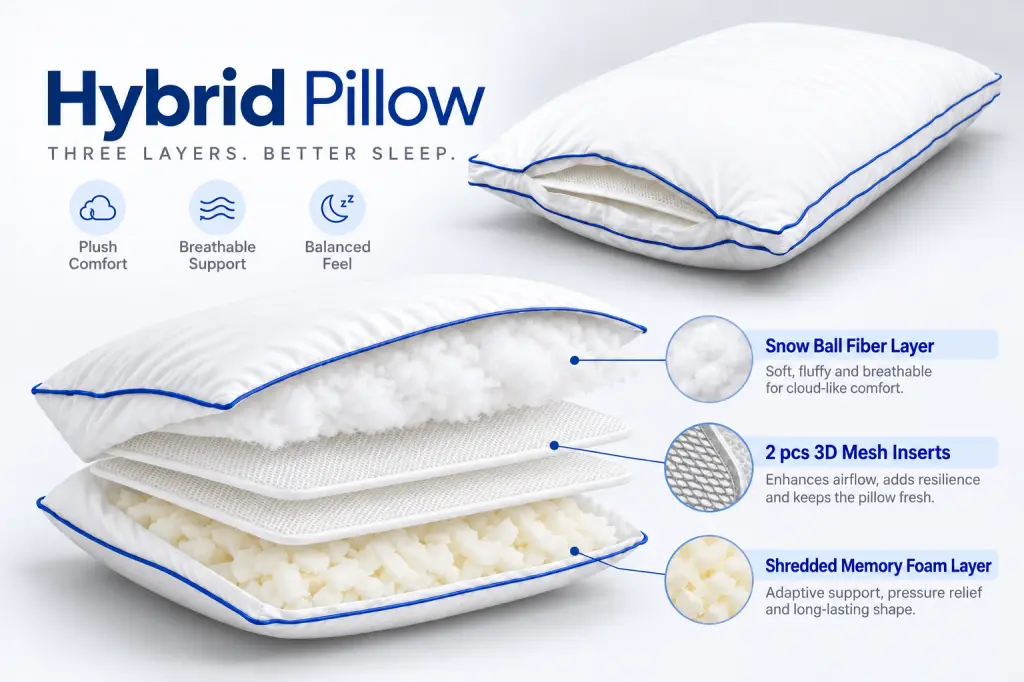
The Layered Adjustable Height Adult Sleeping Pillow combines:
- snow ball fiber;
- shredded slow-rebound memory foam;
- removable 12 mm 3D mesh inserts.
Instead of choosing one material for the entire pillow, each layer performs a different function.
What Does the Memory Foam Layer Do?
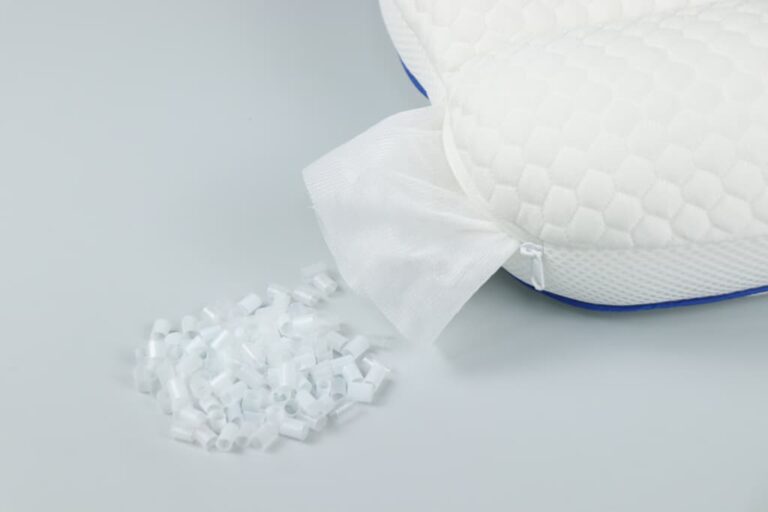
The lower pillow section uses shredded slow-recovery polyurethane memory foam.
The shredded structure allows the foam pieces to move and adapt to different pressure areas.
This creates:
- denser support;
- pressure-adaptive comfort;
- a more traditional foam sleeping sensation.
Compared with a solid molded foam block, shredded foam can also be adjusted more easily through filling quantity.
What Do the 3D Mesh Inserts Do?
One or two 12 mm 3D mesh pads can be inserted between the pillow layers.
These inserts do not replace the memory foam.
Instead, they provide:
- additional height;
- firmer support;
- more airflow;
- faster moisture release.
This creates several configurations from one pillow.
For example:
No mesh insert
→ lower and softer
One 12 mm insert
→ higher and more supportive
Two 12 mm inserts
→ higher again with stronger structural support
Mefiss Insight
This is a good example of a hybrid product-development principle:
Use memory foam where contouring is needed. Use 3D mesh where airflow and structural height are needed.
The 3D Mesh Used in This Product
This pillow uses T2S-6L 3D mesh.
It has a one-piece, glue-free spacer construction.
The hollow internal structure helps provide:
- ventilation;
- moisture transfer;
- quick drying;
- dimensional stability;
- resilient rebound.
The mesh is produced by Mefiss Textile, our own warp-knitted fabric factory.
This gives us more flexibility when adjusting 3D mesh specifications for different pillow structures.
A Pure Mesh-Led Pillow Takes a Different Approach
A second product shows a different strategy.
Instead of using memory foam as one of the main comfort materials, the pillow structure is built around breathable spacer mesh and washable fillings.
Real Product Example 2: Breathable Mesh Adjustable Cervical Support Pillow
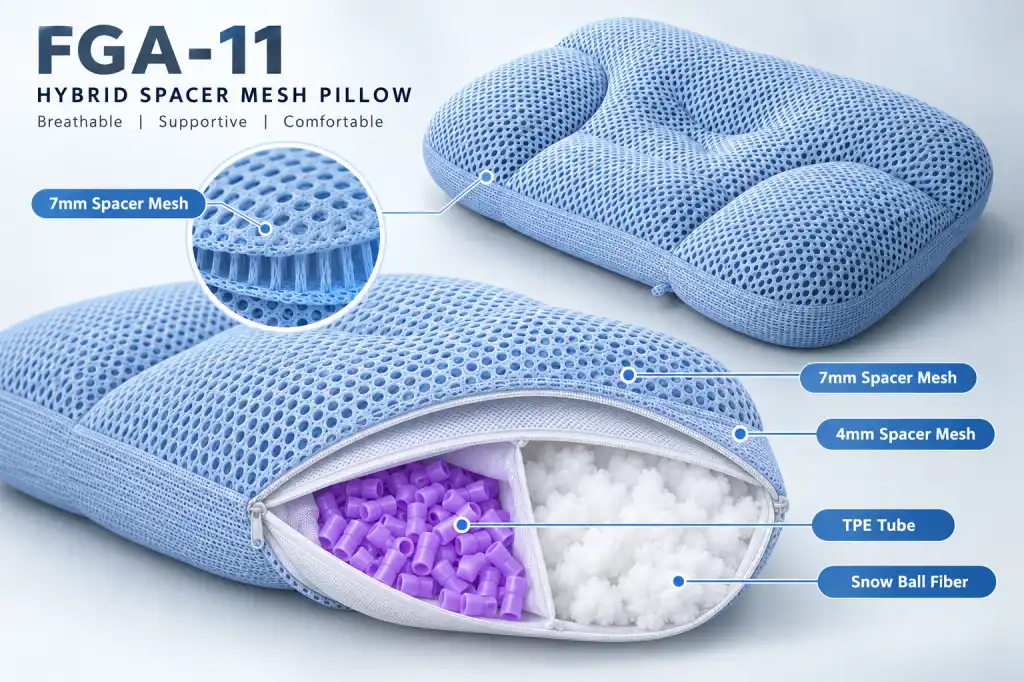
The Breathable Mesh Adjustable Cervical Support Pillow is an adult pillow designed around maximum ventilation.
The pillow uses spacer mesh across the main fabric surfaces.
Its structure includes:
- 7 mm spacer mesh;
- 4 mm spacer mesh;
- hollow TPE tube filling;
- snow ball fiber;
- independently adjustable filling zones.
There is no conventional memory foam core.
The design goal is different from a traditional foam pillow.
Why Use Mesh Across the Pillow?
Using mesh only on a small decorative area would have limited impact.
In this product, the mesh is used more extensively so heat and moisture have more pathways to leave the pillow.
The front uses a thicker 7 mm spacer mesh.
The reverse uses a softer 4 mm structure.
Together they provide:
- airflow around the head and neck;
- quick drying;
- elastic surface support;
- reduced heat accumulation.
Mefiss Insight
If airflow is the main product concept, the breathable material should not be hidden behind several dense layers.
The final construction must preserve the material advantage.
Why Use TPE Tubes Instead of Memory Foam?
The neck and side zones use hollow TPE tubes.
The filling can move within each chamber, allowing pressure to distribute across the zone.
Compared with memory foam, the tubes provide a different feel:
- firmer;
- more mobile;
- less body-contouring;
- more ventilated.
Their hollow shape also provides additional airflow space inside the pillow.
This makes them suitable for a pillow focused on:
ventilation + adjustable support + washability
rather than deep contouring.
3D Mesh Does Not Always Need to Be the Entire Core
This is important for product development.
When brands hear “3D mesh pillow,” they sometimes imagine that the entire pillow must be built from thick mesh.
That can become expensive and unnecessarily firm.
A more practical approach may be to use 3D mesh as:
- a height insert;
- a surface support layer;
- a side panel;
- a ventilation layer;
- a removable support pad.
This gives the product many of the airflow advantages without requiring the complete pillow to use one material.
Why Very Thick 3D Mesh Can Cost More
A thick mesh core can require multiple layers.
For example, if a pillow needs several centimeters of mesh thickness, multiple pieces may need to be:
- cut;
- stacked;
- sewn;
- fixed together.
This creates additional:
- material consumption;
- cutting waste;
- sewing work;
- assembly cost.
Memory foam is much easier to cut from a large block into a thick shape.
This is one reason why 3D mesh is often more practical as a functional layer rather than the entire core.
Shape Development: Memory Foam Is Easier
If the pillow needs a complex ergonomic shape, memory foam normally has an advantage.
Foam can be:
- molded;
- CNC cut;
- sculpted;
- perforated;
- contoured.
3D mesh is a textile structure.
Although it can be cut into different outlines, it does not easily create complex three-dimensional curves by itself.
For a highly contoured cervical pillow, foam may therefore be more practical.
For a pillow where the main goal is:
- ventilation;
- flat height adjustment;
- resilient layers;
3D mesh may be more suitable.
What About Washing?
This is another major difference.
3D Mesh
A polyester 3D mesh insert can usually be washed and dried relatively easily.
Its open structure helps water drain quickly.
Memory Foam
Conventional memory foam is generally better protected from repeated direct washing.
The pillow should normally use a removable washable cover.
This means product-care instructions should be defined during development.
Do not wait until packaging is finished to decide how consumers should clean the pillow.
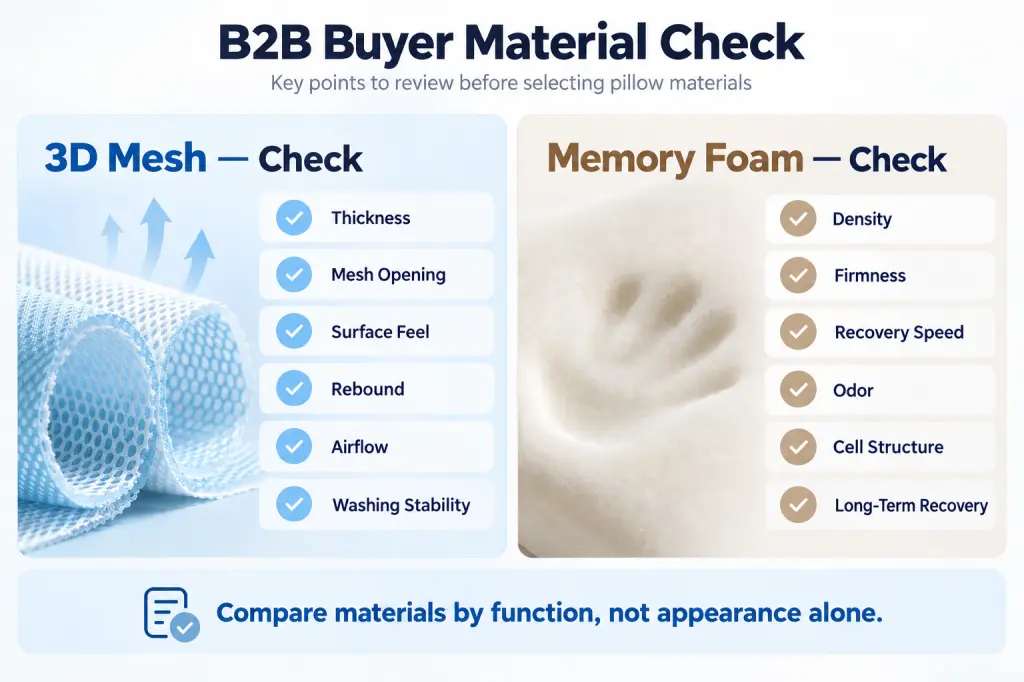
How Should B2B Buyers Compare Samples?
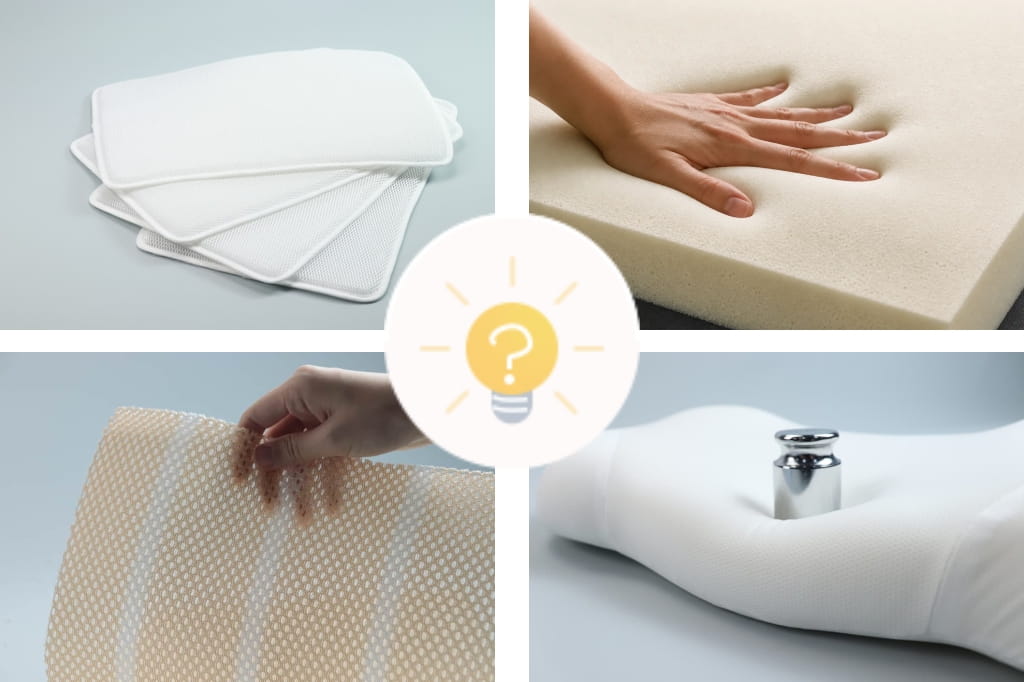
When evaluating 3D mesh and memory foam, do not compare them with one simple hand press.
Check them according to their intended role.
For 3D Mesh
Check:
- thickness;
- mesh opening;
- surface softness;
- rebound;
- monofilament stiffness;
- airflow;
- recovery after compression;
- washing stability.
For Memory Foam
Check:
- density;
- firmness;
- recovery speed;
- odor;
- cell consistency;
- contouring feel;
- long-term recovery.
For the Finished Pillow
Check:
- overall height;
- neck support;
- heat buildup;
- moisture release;
- sleeping position;
- cover compatibility.
The finished pillow matters more than the material sample alone.
Can 3D Mesh and Memory Foam Be Used Together?
Yes.
In many cases, this is actually the most practical solution.
For example:
Shredded Memory Foam
provides:
- contouring;
- pressure adaptation;
- soft support.
While:
3D Mesh Insert
provides:
- adjustable height;
- ventilation;
- resilient structural support.
This creates a product that does not depend on one material to solve every problem.
Mefiss Insight
Hybrid construction often gives brands more control than simply choosing a “better” material.
The important question is which material should perform each function.
Which Material Should You Choose?
Choose 3D mesh when the product needs:
- maximum airflow;
- quick drying;
- washable inserts;
- resilient height adjustment;
- less heat accumulation.
Choose memory foam when the product needs:
- contouring;
- pressure adaptation;
- softer wrapping comfort;
- complex ergonomic shapes;
- easier compression packaging.
Consider a hybrid construction when you need both.
What Information Should You Send to a Pillow Manufacturer?
Before requesting a sample, prepare:
- Pillow size
- Target user
- Target sleeping position
- Target height
- Preferred firmness
- Required airflow level
- Washing requirement
- Fixed or adjustable height
- Foam or mesh preference
- Cover material
- Packaging requirement
- Estimated order quantity
If you are unsure about the material, describe the sleeping experience you want.
For example:
“We want an adult pillow with memory-foam comfort, but we need better ventilation and adjustable height.”
This is much more useful than simply saying:
“Please quote 3D mesh.”
Material Compliance Should Match the Actual Material
For memory foam and textile materials, buyers should request reports that match the material actually used in production.
Chemical requirements vary by destination market.
For products sold in the European Union, REACH requirements may be relevant depending on the materials and substances involved.
Buyers sourcing foam, textile and polymer materials for the EU market can review the European Chemicals Agency — REACH Candidate List Information when evaluating relevant chemical requirements.
Test reports should be checked against:
- material specification;
- supplier;
- production batch or relevant scope;
- actual product claim.
Do not assume that one report automatically covers every version of a material.
FAQ
Is 3D mesh more breathable than memory foam?
Generally, yes. Thick 3D mesh has large open internal channels, so air and moisture can move through the structure more easily than through conventional memory foam.
Is 3D mesh more comfortable than memory foam?
Not necessarily. Memory foam normally offers stronger contouring and softer pressure adaptation. 3D mesh feels more springy and structured.
Can 3D mesh be used as a pillow core?
Yes. It can be used as a full core, insert, height-adjustment layer or ventilation layer depending on the product design.
Can memory foam be washed?
Conventional memory foam is normally not designed for frequent direct washing. A removable washable pillowcase is usually the more practical cleaning solution.
Why combine 3D mesh and memory foam?
Memory foam provides contouring comfort, while 3D mesh can add airflow, height and resilient support. The two materials can solve different functions in the same pillow.
Is thicker 3D mesh always better?
No. Greater thickness increases height and support, but it can also increase firmness, cost and material usage. Thickness should match the complete pillow design.
Final Thoughts
3D mesh and memory foam are not direct substitutes.
They provide different types of value.
Memory foam is strong in:
contouring + pressure adaptation + ergonomic shaping
3D mesh is strong in:
airflow + quick drying + elastic rebound + washable support
For some products, one material is clearly more suitable.
For others, the best answer is a hybrid structure.
The Layered Adjustable Height Adult Sleeping Pillow is a good example: memory foam provides contouring comfort, while removable 3D mesh inserts add height, airflow and structural support.
The Breathable Mesh Adjustable Cervical Support Pillow shows another direction: when ventilation and washability are the main design goals, a mesh-led structure can reduce the need for conventional foam.
For brands developing a new pillow, start with the required sleeping experience.
Then choose the material for each function.
Developing a Breathable Pillow?
Mefiss is a custom pillow manufacturer supporting adult, kids and functional pillow development.
We can develop:
- 3D mesh inserts;
- spacer mesh pillow structures;
- shredded memory foam;
- molded memory foam;
- TPE tube filling;
- adjustable pillow heights;
- zoned support structures;
- cooling pillowcases;
- removable washable covers.
Tell us your target user, pillow size, height, firmness, airflow requirement and target market. We can recommend a practical starting structure for sampling.