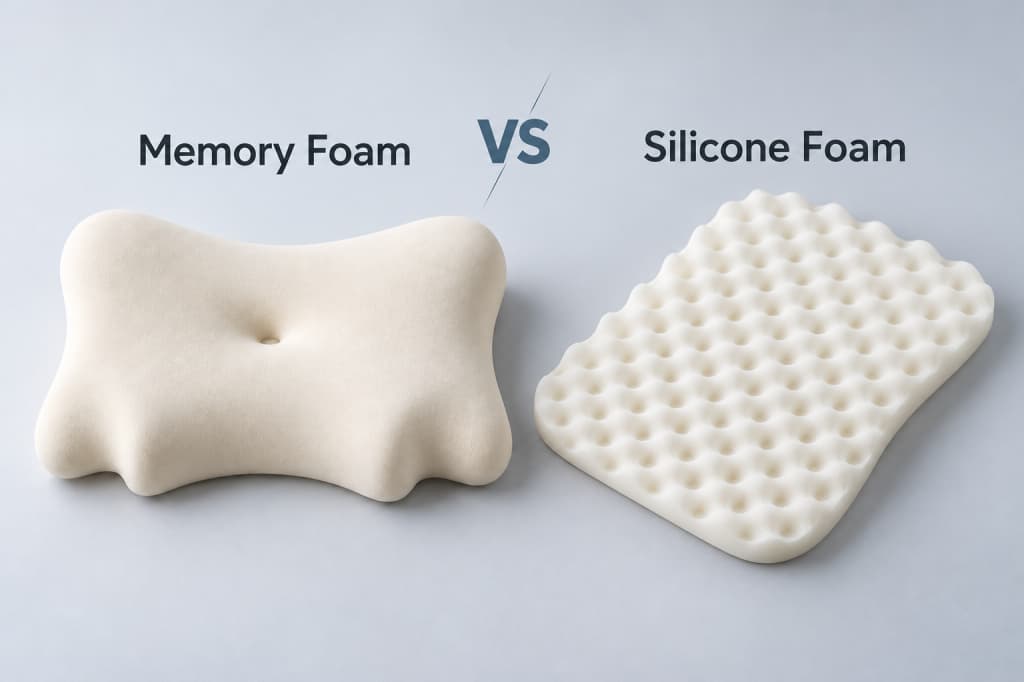
For brands developing custom pillows, choosing between silicone foam and memory foam affects comfort, product shape, tooling costs, washability, and the overall manufacturing process.
At Mefiss Hometex, we develop pillow products using different core materials to meet different market needs. Our FBA-231 memory foam kids pillow and FBA-131A silicone kids pillow illustrate two distinct approaches to custom pillow development.
This guide compares the two materials from a manufacturer’s perspective, focusing on comfort, shaping methods, development costs, cleaning, and practical sourcing decisions.
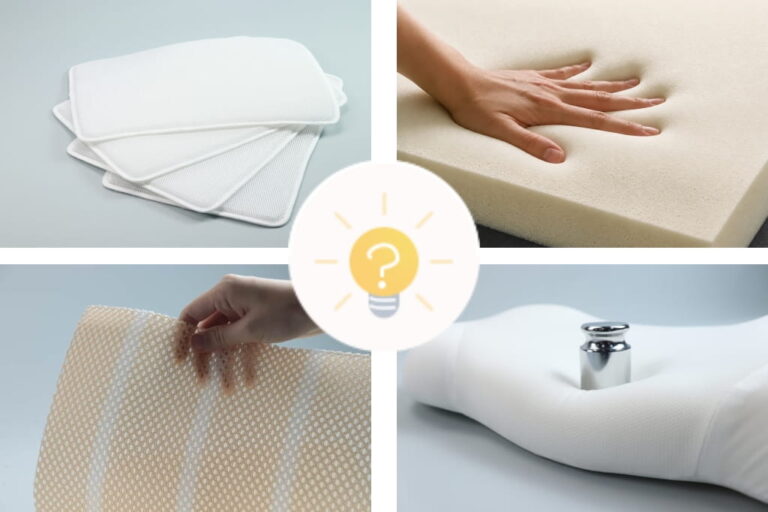
1|Silicone Foam vs Memory Foam: Key Differences
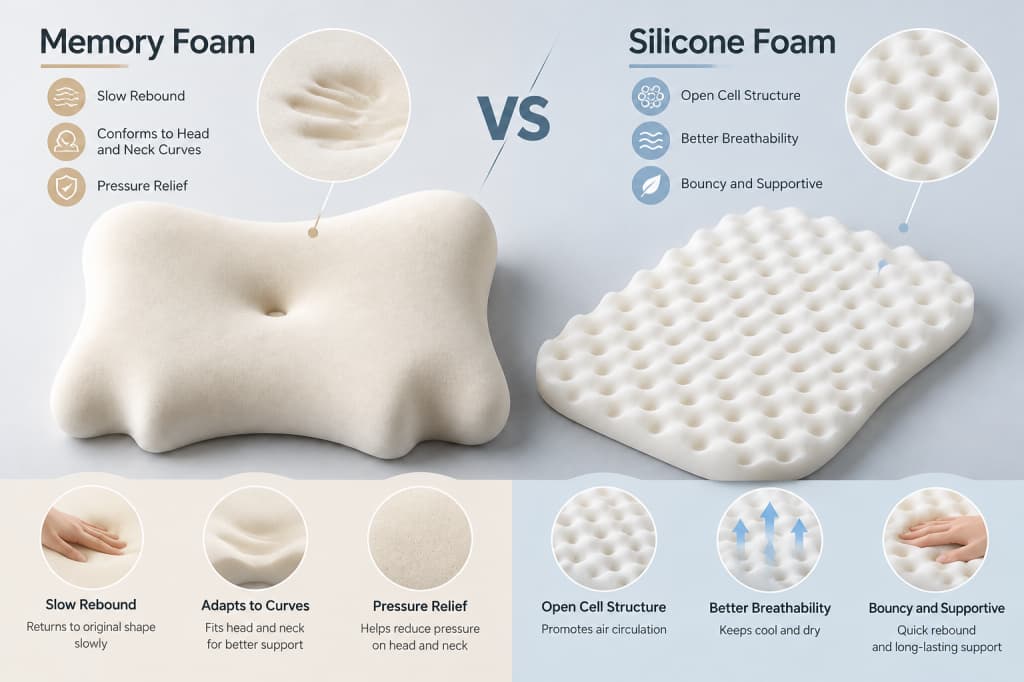
Memory foam is a viscoelastic polyurethane foam known for its slow recovery and close contouring. Silicone foam offers a more immediate elastic response and can be developed as a washable pillow core with an open-cell structure.
For custom pillow development, the most important differences are not limited to firmness. The manufacturing method, intended sleeping experience, cleaning requirements, and target price should guide material selection.
| Comparison | Memory Foam | Silicone Foam |
|---|---|---|
| Sleeping feel | Slow recovery and close contouring | More immediate elastic response |
| Common processing methods | Molded foaming, block cutting, CNC shaping | Sheet cutting, profile cutting, perforation |
| Shape development | Suitable for complex three-dimensional contours | Sheet processing suits simpler profiles and layered designs |
| Airflow | Depends on formulation and cell structure | Open-cell structures support airflow |
| Washing | Conventional cores are generally not designed for direct washing | Washable core material |
| Tooling investment | A new mold may be needed for a custom molded shape | Sheet-cut designs can reduce dedicated tooling costs |
These are typical manufacturing approaches. The final choice depends on the required pillow shape, material specification, cleaning needs, and production budget.
2|Molding vs Sheet Cutting: Shape and Development Costs
2.1|Memory Foam: Greater Freedom for Complex Shapes
One important advantage of memory foam is its suitability for molded three-dimensional designs. A pillow can incorporate a recessed head area, a raised neck support zone, curved side sections, or other customized contours.
Memory foam can also be processed through block cutting or CNC shaping. These methods are useful for prototypes, simpler profiles, and projects that do not require a dedicated mold.
Based on Mefiss’s current development experience, a conventional new pillow mold typically costs approximately RMB 2,000–3,000. The final cost depends on the mold dimensions, design complexity, and manufacturing process.
For brands planning repeat orders, the tooling cost can be distributed across future production runs. For a small trial order, adapting an existing design or starting with a cut-foam prototype can help reduce the initial investment.
Mefiss Manufacturing Insight: Define the head recess, neck support height, and overall contour before choosing the production method. A clear design brief helps control tooling costs and avoid unnecessary sample revisions.
2.2|Silicone Foam: A Direct Route for Simpler Designs
For many silicone foam pillow projects, sheet cutting, profile cutting, and perforation provide a practical starting point. Different thicknesses can also be combined to create different pillow heights and layered structures.
Compared with developing a dedicated molded core, sheet processing can reduce upfront tooling costs. It is especially useful when the product relies on core thickness, resilient support, and a relatively straightforward outline.
For complex three-dimensional curves or integrated molded structures, the manufacturing method should be considered at the design stage rather than after the product shape has been finalized.
Explore our open-cell silicone foam collection for more information about silicone foam applications.
3|Comfort, Airflow, and Washability
3.1|Memory Foam: Slow Recovery and Contouring
Memory foam is a viscoelastic polyurethane material. Under pressure, it gradually conforms to the head and neck. Once the pressure is removed, it recovers progressively rather than immediately.
This response is useful for pillows designed around close contouring and a cushioned sleeping feel. Manufacturers can adjust the material specification and pillow profile to create different support experiences.
Conventional memory foam cores are generally not designed for direct washing. For products that require easy maintenance, a removable, washable cover is a practical construction choice.
3.2|Silicone Foam: Resilient Support and Washable Construction
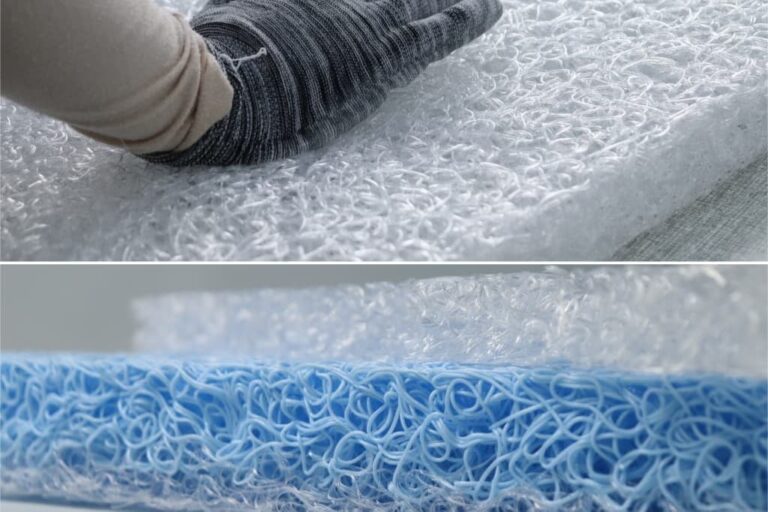
Silicone foam generally provides a more immediate elastic response than slow-recovery memory foam. In open-cell constructions, interconnected pores allow air and water to move through the material.
Mefiss’s product records include silicone foam cores with a measured open-cell ratio above 90%. Some designs also incorporate additional perforations to improve airflow and moisture movement.
Silicone foam is a washable pillow core material. For example, our silicone pillow designs can be directly washed, including products developed for high-temperature washing and quick drying. This makes silicone foam a practical choice for brands looking to develop washable pillows rather than products that rely only on a removable cover.
Explore our breathable baby pillow development approach to learn more about how core structure and cover materials work together.
4|Real Product Example: FBA-231 Memory Foam Kids Pillow
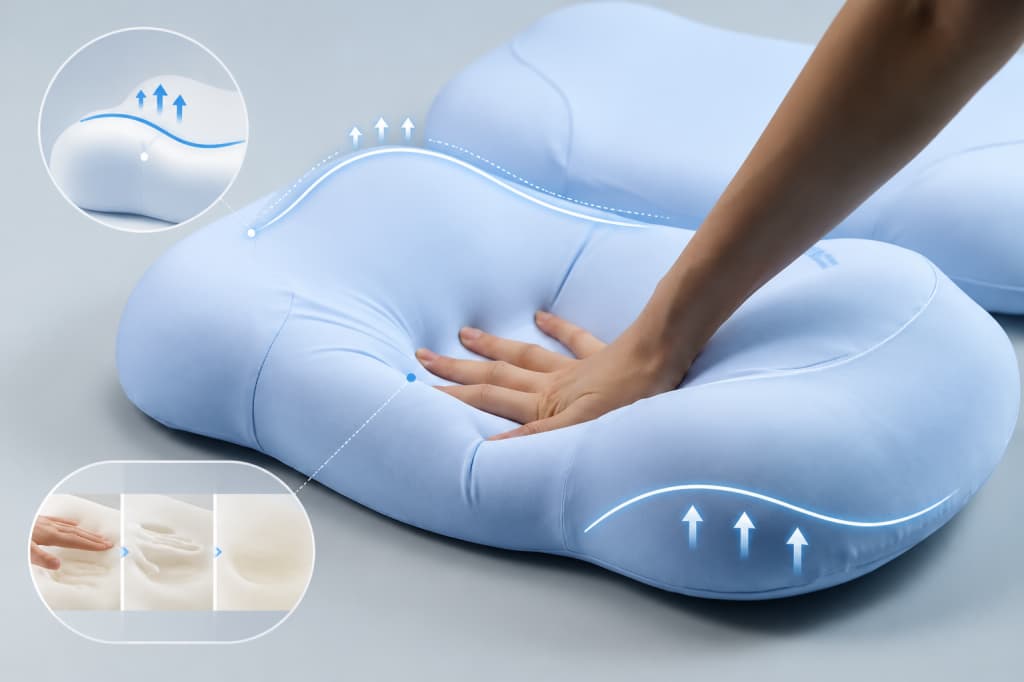
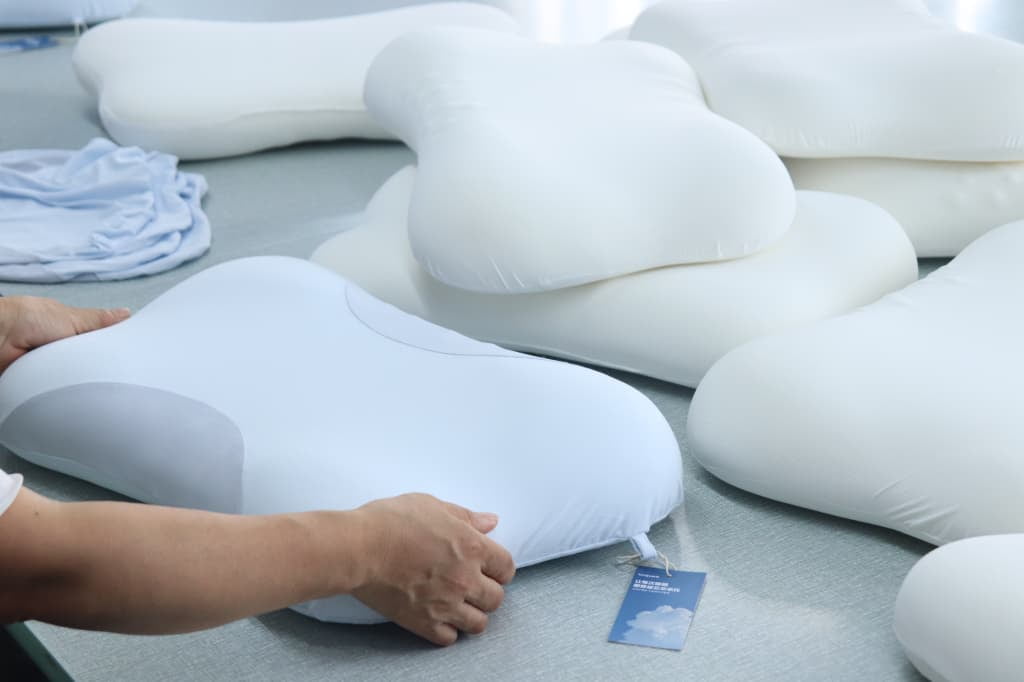
The Mefiss FBA-231 is a bio-based memory foam kids pillow featuring a raised neck area and a recessed head area. Its contoured construction illustrates how memory foam can create different support zones within one pillow.
| Specification | FBA-231 |
|---|---|
| Product size | 52 × 28.5 × 7 cm |
| Net weight | 696 g, without packaging |
| Core material | Bio-based memory foam |
| Core cover | High-stretch knitted fabric |
| Outer cover | CoolFlex Nylon 01, nylon and elastane |
The product also uses heat-transfer branding and care labels. A visual reminder is incorporated into the replacement-cover label, helping consumers identify when the cover should be considered for replacement.
For brands developing a similar product, the key decisions include the contour profile, neck support height, core firmness, cover construction, and the number of sizes required for the target market.
Browse the Mefiss product collection for more examples of our finished pillow designs.
5|Real Product Example: FBA-131A Silicone Kids Pillow
The Mefiss FBA-131A silicone kids pillow represents another approach to pillow development. Alongside the finished product, Mefiss has corresponding testing documentation that supports B2B customer evaluation and product compliance discussions.
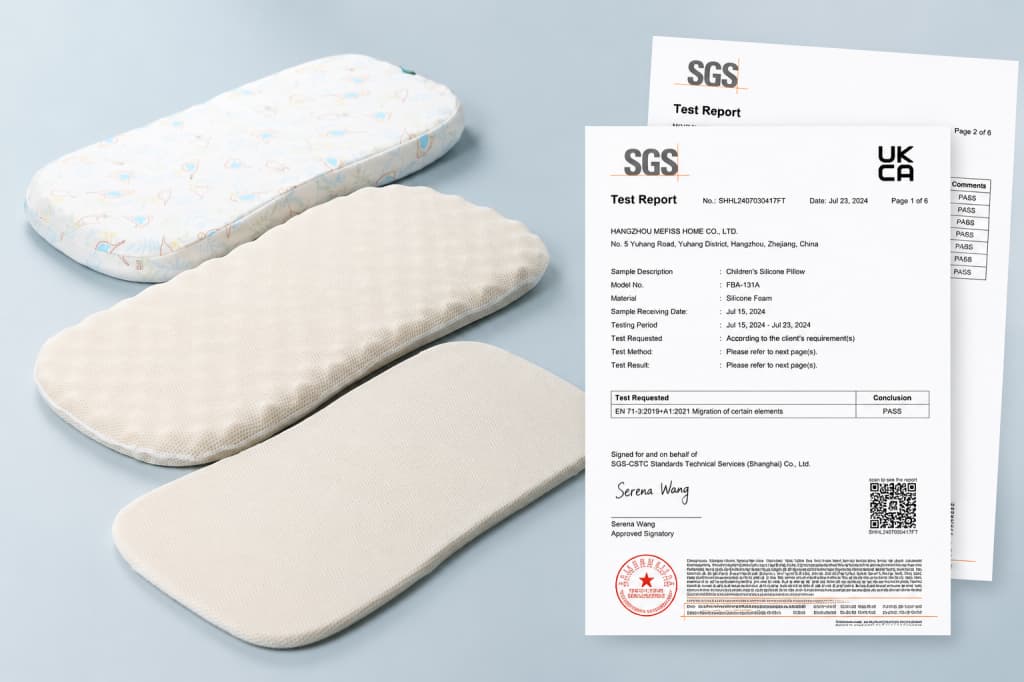
The supplied certificate identifies model FBA-131A and certificate number LC-240910092630. It lists the following standards:
- BS EN 62321-5:2014
- BS EN 62321-4:2014+A1:2017
- BS EN 62321-6:2015
- BS EN 62321-7-2:2017
- BS EN 62321-8:2017
For brands sourcing silicone kids pillows, product-specific testing documentation can support supplier evaluation and the preparation of technical documents for the intended market. Mefiss can discuss the product requirements and relevant documentation during development.
For products intended for the UK market, buyers can also refer to the UK government’s official UKCA marking guidance.
The FBA-131A example demonstrates how product development and testing documentation can work together to support B2B sourcing discussions.
6|Cost and Processing: What Buyers Should Budget For
Material price is only one part of the total cost of a custom pillow. Tooling, processing yield, product weight, packaging, and shipping also influence the final sourcing decision.
| Cost Factor | Memory Foam | Silicone Foam |
|---|---|---|
| Raw material | Generally more economical | Typically more expensive, depending on formulation and grade |
| Tooling | A conventional new pillow mold typically costs RMB 2,000–3,000 | Suitable sheet-cut designs can reduce dedicated tooling requirements |
| Processing | Block cutting, CNC shaping, and molding are common options | Sheet cutting and perforation suit many simpler structures |
| Shipping | Compression packaging may be possible | Higher product weight can increase freight costs |
Based on Mefiss’s current sourcing experience, silicone foam raw material can cost approximately two to four times as much as memory foam, depending on the formulation and specification. This is a project planning reference rather than a fixed market price.
Silicone foam is also generally heavier than memory foam in comparable pillow applications. For e-commerce brands or buyers shipping by air, finished product weight and package dimensions should be considered early in the development process.
For durability evaluation, buyers can discuss compression recovery and permanent deformation testing with their supplier. ISO 1856 describes methods for determining compression set in applicable flexible cellular materials.
7|How to Choose the Right Material for Your Pillow Project
The most efficient approach is to define the product concept first, then select a material and manufacturing method that fit the target budget.
| Project Requirement | Recommended Starting Point |
|---|---|
| Complex three-dimensional contours | Molded memory foam |
| Slow recovery and close contouring | Memory foam |
| Washable core and resilient feel | Silicone foam |
| Small initial order and limited tooling budget | Review existing designs and sheet-cut options |
| Long-term differentiated product line | Compare tooling investment with planned order volume |
Before requesting a sample, provide your manufacturer with the target dimensions, desired firmness, intended user group, cover requirements, target price, estimated order quantity, and packaging preferences.
These details help the manufacturer select an appropriate core material and processing route before sampling begins, reducing unnecessary design changes later.
8|Frequently Asked Questions
8.1|Which material is better for an ergonomically shaped pillow?
For complex three-dimensional contours, molded memory foam is often the more practical starting point. It can form recessed head areas, raised neck support zones, and curved side sections. Silicone foam sheet cutting is better suited to simpler profiles and layered constructions.
8.2|How much does a custom memory foam pillow mold cost?
Based on Mefiss’s current development experience, a conventional new pillow mold typically costs approximately RMB 2,000–3,000. The final quotation depends on the product dimensions, design complexity, and manufacturing process.
8.3|Can silicone foam pillow cores be washed directly?
Yes. Silicone foam is a washable pillow core material. Mefiss silicone pillow designs include cores that can be washed directly, with selected products designed for high-temperature washing and quick drying.
8.4|Can memory foam pillows be vacuum compressed for shipping?
Some memory foam pillows can be compressed for packaging. The compression ratio, storage period, and recovery after unpacking should be considered when selecting a packaging method.
8.5|What information should buyers provide before requesting a sample?
Provide the pillow dimensions, desired firmness, preferred core material, cover fabric, cleaning requirements, package dimensions, target market, and estimated order quantity. If a new molded shape is required, discuss the tooling quotation before approving development.
9|Conclusion: Choose the Material and Manufacturing Method Together
Memory foam and silicone foam serve different product development priorities. Memory foam is a strong option for slow-recovery comfort and complex molded contours, while silicone foam is suitable for resilient, washable pillow designs.
The Mefiss FBA-231 memory foam kids pillow and FBA-131A silicone kids pillow demonstrate how these materials support different product concepts. The right choice depends on the intended shape, sleeping feel, cleaning requirements, tooling budget, and expected order volume.
Develop Your Custom Pillow with Mefiss Hometex
Planning a new pillow collection? Share your target dimensions, preferred material, desired firmness, cover specifications, packaging requirements, target market, and estimated order quantity. Our team can help you evaluate a suitable pillow core and manufacturing approach for your brand.
Explore Mefiss Products | Explore Silicone Foam | Contact Mefiss Hometex