POE air fiber and memory foam are both used as mattress core materials, but they behave very differently.
Memory foam is well known for soft pressure relief and body contouring.
POE air fiber is better known for its open structure, direct washability, airflow and quick drainage.
For a traditional comfort mattress, memory foam may be the better choice.
For a mattress designed around washing, airflow and visible cleanliness, POE air fiber often offers advantages that conventional memory foam cannot easily provide.
After developing mattresses with POE air fiber, memory foam, spacer mesh and mixed-material structures, we have learned that the most useful question is not:
“Which material is better?”
It is:
“What does the finished mattress need to do?”
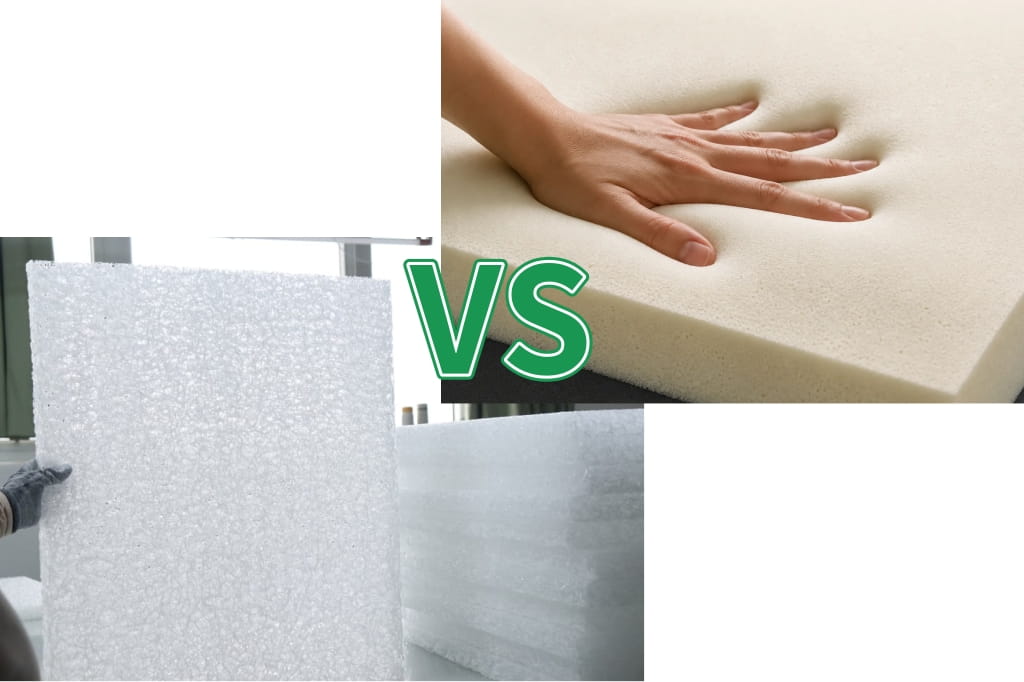
The Basic Difference: Open Fiber Structure vs Foam Structure
POE air fiber and memory foam are made in very different ways.
POE Air Fiber
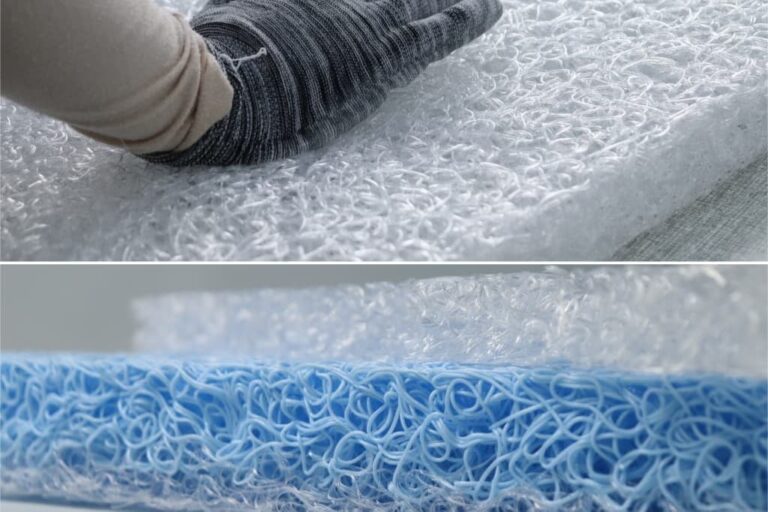
POE air fiber is formed from continuous thermoplastic fibers.
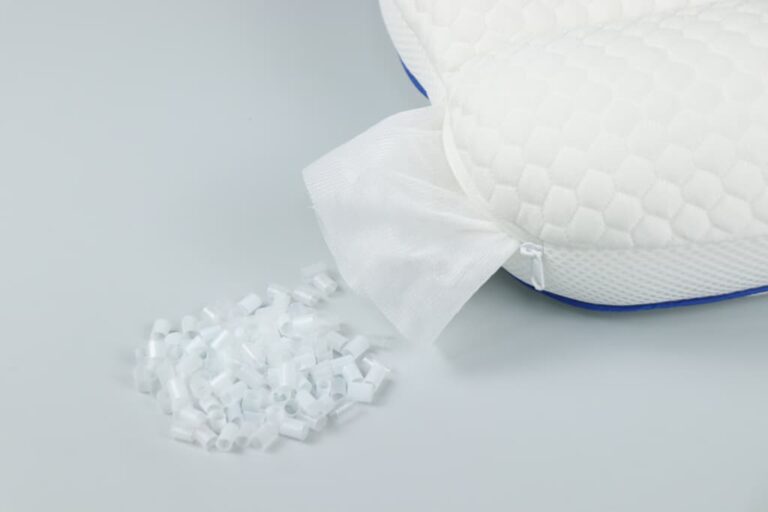
The material is melted, extruded through small openings, connected into a three-dimensional structure and cooled during forming.
This creates large open spaces throughout the core.
These spaces allow:
- air to pass through;
- water to drain;
- heat to escape;
- moisture to move through the structure.
Memory Foam
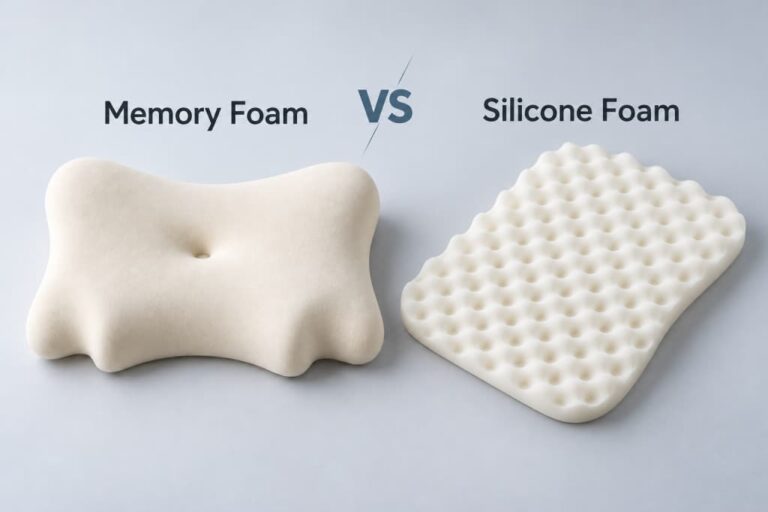
Memory foam is a type of flexible polyurethane foam.
Its internal structure consists of many small cells rather than large open channels.
The material reacts slowly to pressure and gradually returns toward its original shape.
This slow-response behavior is what gives memory foam its familiar body-contouring feel.
For general background on flexible polyurethane foam manufacturing, the U.S. Environmental Protection Agency provides information about the industry and manufacturing process through its Flexible Polyurethane Foam Production guidance.
POE Air Fiber vs Memory Foam at a Glance
| Feature | POE Air Fiber | Memory Foam |
|---|---|---|
| Structure | Open interconnected fibers | Cellular foam |
| Direct water washing | Very suitable | Usually not recommended |
| Drainage | Fast | Slow |
| Drying | Relatively fast | Relatively slow |
| Airflow | Very high | Lower |
| Body contouring | Moderate | Strong |
| Soft wrapping feel | Limited | Excellent |
| Firmness customization | Yes | Yes |
| Dual-firmness core | Possible | Possible through layering or foam selection |
| Complex shapes | More difficult | Easier |
| Vacuum compression | Poor | Good |
| Visible internal cleanliness | High | Low |
| Typical material cost | Higher than standard PU foam | Usually lower than POE |
| Best use | Washable, breathable products | Comfort and pressure-relief products |
This comparison is only a general product-development reference.
Actual performance depends on density, thickness, formulation and the complete mattress structure.
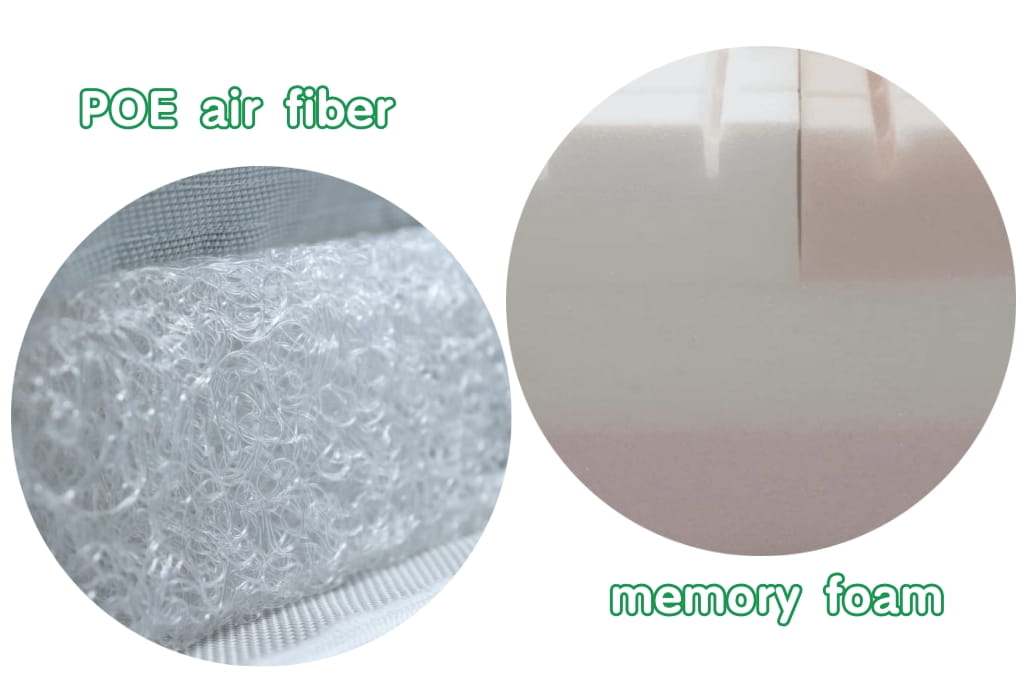
1. Washability: This Is the Biggest Difference
If the project requires a truly washable mattress core, POE has a clear advantage.
POE Air Fiber
POE itself absorbs very little water.
During cleaning, water moves through the open fiber structure and drains away.
The core can normally be rinsed directly with water and then air dried.
This makes it useful for products such as:
- baby mattresses;
- kids mattresses;
- healthcare mattresses;
- pet mattresses;
- washable cushions;
- stroller pads.
Memory Foam
Memory foam is very different.
Water can enter the cellular structure, and drying a thick foam block can take a long time.
For this reason, most memory foam products are designed around:
- a removable washable cover;
- spot cleaning;
- keeping the core itself relatively dry.
If regular core washing is one of the main product requirements, we normally do not treat conventional memory foam as the first choice.

2. Airflow: POE Has a Structural Advantage
A mattress can feel hot for many reasons.
The core structure is only one part of the problem, but it matters.
POE air fiber contains large continuous spaces throughout the material.
Air and moisture can move through these channels relatively easily.
Memory foam is much denser.
Even when the foam is described as open-cell, the path for airflow is much smaller than the large openings inside an air-fiber core.
For products where ventilation is a major selling point, POE therefore has a structural advantage.
However, there is an important limitation:
A breathable core is only useful when the cover also allows the mattress to breathe.
If a POE core is wrapped in a dense waterproof membrane, the final mattress may still have poor airflow.
This is why we often combine POE with spacer mesh or 3D mesh instead of treating the core as an independent component.
3. Comfort: Memory Foam Still Has an Important Advantage
This is where many POE comparisons become too one-sided.
POE is not better at everything.
Memory foam has a very clear comfort advantage:
It Conforms to the Body
When pressure is applied, memory foam slowly compresses and follows the shape of the body.
This creates:
- stronger contouring;
- softer pressure distribution;
- a deeper wrapping feeling.
POE has elastic support, but the feeling is different.
It is more springy and open.
For a customer who wants a very soft, deep and enveloping mattress feel, memory foam may be much easier to work with.
Mefiss Insight
This is one reason we rarely evaluate mattress cores without considering the cover.
A POE core may have excellent airflow and support, but if the sleeping surface is too simple, the finished mattress can feel harder than customers expect.
We therefore often add:
- quilted comfort layers;
- thicker spacer mesh;
- 3D mesh;
- softer top fabrics.
The goal is not to hide the POE core.
It is to compensate for the areas where POE is naturally weaker.
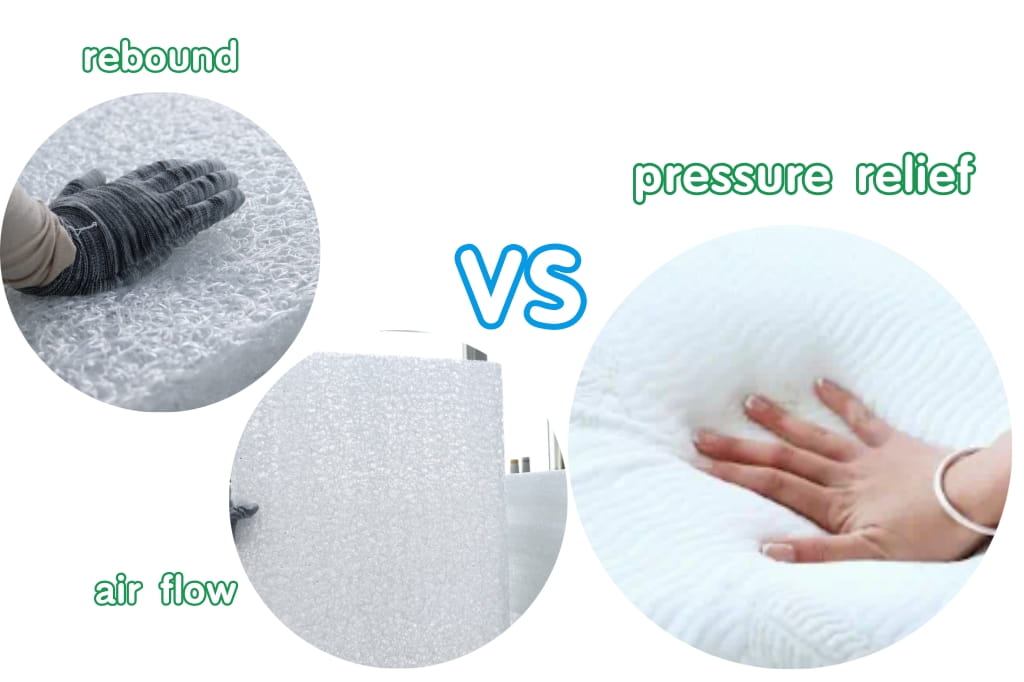
4. Firmness: Density Alone Is Not Enough for Either Material
Both materials are often sold using density numbers.
But density does not completely define comfort.
For POE air fiber, firmness is affected by:
- density;
- core thickness;
- fiber diameter;
- raw material formulation;
- fiber arrangement;
- open-space ratio;
- surface construction.
For memory foam, the final feel can also vary according to:
- density;
- firmness formulation;
- thickness;
- temperature sensitivity;
- foam recovery speed;
- supporting foam underneath.
This means two materials with similar density numbers cannot be compared directly.
A 55D POE core and a foam with a similar nominal density are not supposed to feel the same.
They are completely different material systems.
Our Practical POE Density Reference
For an approximately 8 cm POE core, our development experience is roughly:
| POE Density | Typical Feel | Common Development Direction |
|---|---|---|
| 45D | Softer and more flexible | Kids |
| 55D | Medium to firm support | Teenagers |
| 60D | Firmer with stronger rebound | Adults |
These are development references rather than medical standards.
Thickness must always be considered together with density.
For example:
- 55D at 4 cm usually feels firmer;
- 55D at 8 cm usually feels more elastic and less rigid.
This is why we do not recommend choosing a POE mattress only by asking:
“What density is it?”
5. Long-Term Recovery Depends on Material Quality
Both POE and memory foam can lose performance if the raw material or production quality is poor.
For POE, we pay particular attention to:
- raw material quality;
- fiber connection points;
- rebound uniformity;
- permanent thickness loss.
Lower-quality POE may initially look similar to better material.
But when pressed repeatedly, it may feel more rigid, recover more slowly or develop local collapse.
One long-term example from our own use involved a 55D, 5 cm POE core used by a person weighing around 80 kg for approximately two years.
Only slight thickness loss appeared around the waist and hip area, and the overall rebound remained good.
This is not a universal durability guarantee.
It shows why an approved sample and long-term performance are more important than density alone.
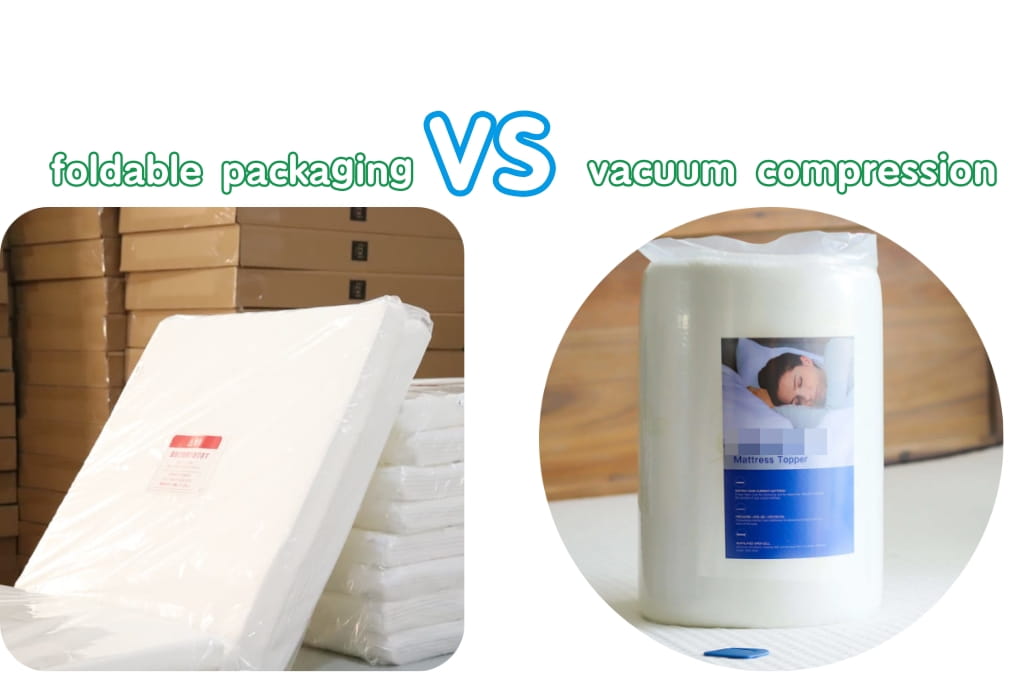
6. Vacuum Compression: Memory Foam Wins
This is one area where memory foam has a major logistics advantage.
Memory foam can usually be:
- compressed;
- rolled;
- vacuum packed.
This allows a large mattress to fit into a much smaller shipping carton.
POE air fiber does not behave the same way.
We normally do not recommend aggressive vacuum compression because the fiber structure may develop permanent deformation.
Long-term sharp folding is also not ideal.
This means POE mattresses can have higher transportation costs.
How We Manage This
For larger POE mattresses, we often consider:
- two-fold structures;
- three-fold structures;
- modular cores;
- separate internal core sections.
This reduces package length without forcing the POE material into extreme compression.
For B2B buyers, this should be considered during product design rather than after the mattress is finished.
7. Complex Shapes: Memory Foam Is Easier to Develop
Memory foam is easier to use for complicated contours.
It can be:
- cut;
- molded;
- carved;
- shaped into ergonomic curves.
POE is produced through fiber extrusion and forming.
Simple rectangular or regular structures are easy to develop.
Very complicated three-dimensional shapes are more difficult.
Special shapes may require:
- dedicated molds;
- production adjustments;
- lower output;
- higher tooling cost.
If a mattress or cushion requires a highly complex ergonomic shape, memory foam may therefore be the more practical material.
8. Visible Cleanliness: POE Has a Unique Product Advantage
Memory foam is opaque.
Consumers cannot see what is happening inside the foam block.
POE is often transparent or semi-transparent.
With high-quality virgin material, the fiber structure can have a clean, crystal-like appearance.
For washable products, this creates an interesting consumer experience:
Cleanliness can be seen as well as claimed.
For some of our customers, this visual characteristic is almost as important as the technical airflow performance.
It helps differentiate POE products from conventional foam mattresses in retail stores and e-commerce product pages.
Real Product Example: FBC-1G Fully Washable POE Kids Mattress
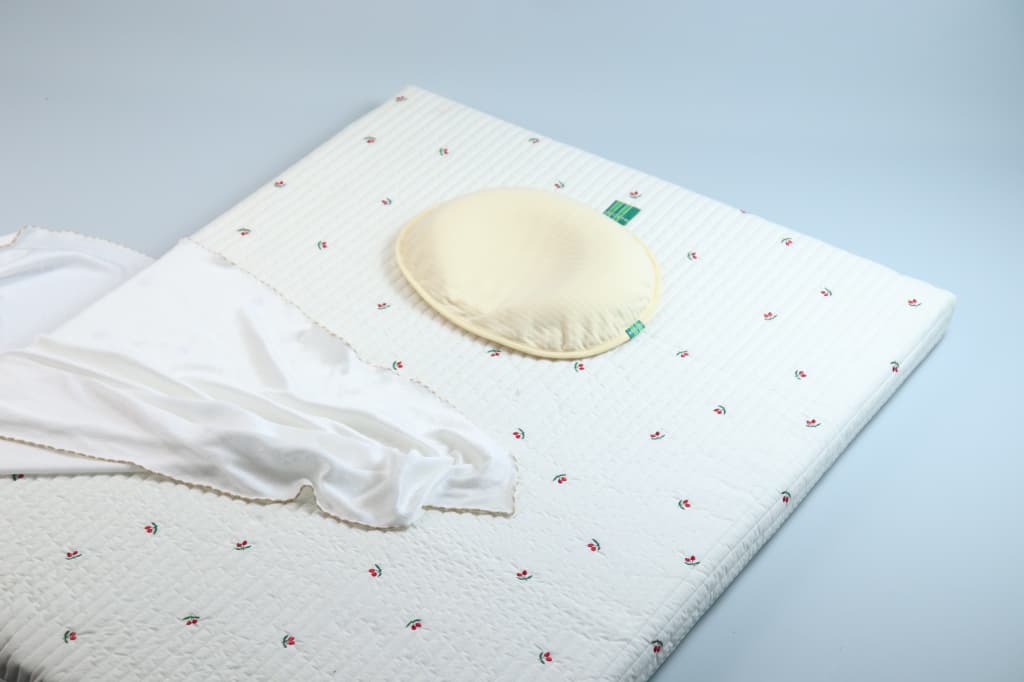
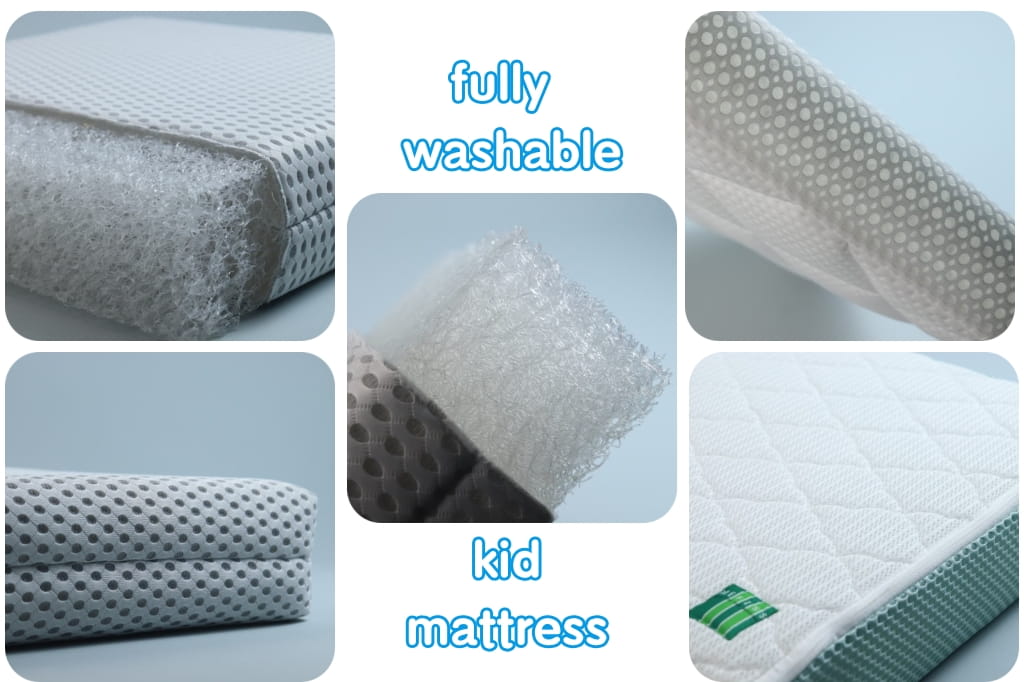
One practical example is our FBC-1G Fully Washable Breathable POE Kids Mattress.
The mattress uses:
- a 9 cm POE air fiber core;
- approximately 55D density;
- a 4 mm Lyocell spacer mesh layer;
- a 5.8 mm honeycomb spacer mesh layer;
- breathable spacer mesh on the sides and bottom.
The sleeping surface reaches approximately 10 mm of combined spacer mesh cushioning.
The core can be rinsed directly and air dried.
This product shows an important design principle:
We do not expect POE to provide every function by itself.
POE provides:
- washable support;
- airflow;
- structural resilience.
The spacer mesh provides:
- additional surface comfort;
- airflow continuity;
- moisture transfer;
- a softer contact layer.
Why Not Simply Replace Memory Foam With POE?
This is another mistake we sometimes see.
A brand has an existing memory foam mattress.
Then someone says:
“POE is more breathable, so let’s replace the foam with POE.”
The result may not be good.
Why?
Because the original mattress was designed around the feel of memory foam.
If the core is replaced without changing the cover and comfort layers, the new version may become:
- harder;
- more springy;
- less contouring;
- less familiar to existing customers.
When changing from memory foam to POE, we normally review the complete construction.
That may include changing:
- cover thickness;
- quilted layers;
- spacer mesh;
- overall mattress thickness;
- POE density;
- surface firmness.
Material replacement should be treated as product redevelopment, not as a one-for-one substitution.
A Hybrid Structure Can Sometimes Be Better
There is also no rule saying the entire mattress must use one material.
For some projects, a hybrid structure can offer a better balance.
For example:
5 cm POE Air Fiber + 3 cm Foam
can create:
- one more breathable and supportive side;
- one softer comfort side;
- lower POE material cost;
- more familiar consumer comfort.
Another option is to use a thinner POE core with a thicker spacer mesh or quilted cover.
This is useful when the brand wants some POE benefits but does not need a 100% POE mattress.
Mefiss Insight
The best material solution is often not the most expensive material used at maximum thickness.
A good development project balances:
performance + comfort + cost + logistics.
Which Material Is Better for Baby and Kids Mattresses?
For baby and kids products, material selection needs additional care.
A mattress should not be selected only because a material is marketed as “breathable.”
The finished mattress structure, firmness, fit and target-market requirements must also be considered.
For POE projects, we normally pay attention to:
- appropriate support;
- sufficient thickness;
- breathable surface materials;
- easy cleaning;
- stable dimensions;
- cover construction.
For memory foam, the design often needs greater attention to:
- surface firmness;
- foam thickness;
- heat retention;
- core cleaning limitations.
For products sold in the United States, mattress manufacturers and importers should also review the applicable federal mattress requirements.
The U.S. Consumer Product Safety Commission explains that mattresses can be subject to 16 CFR Part 1632 for smoldering ignition and 16 CFR Part 1633 for open-flame requirements, while crib mattresses have additional requirements depending on the product.
Refer to the U.S. Consumer Product Safety Commission — Mattresses, Mattress Pads & Mattress Sets for current guidance.
When Should You Choose POE Air Fiber?
POE is usually worth considering when the project prioritizes:
- washable core;
- high airflow;
- quick drainage;
- visible internal cleanliness;
- low odor;
- customizable density;
- dual firmness;
- product differentiation.
Typical applications include:
- baby mattresses;
- kids mattresses;
- teen mattresses;
- breathable adult mattresses;
- healthcare mattresses;
- pet mattresses;
- stroller pads;
- washable cushions.
When Should You Choose Memory Foam?
Memory foam is often more practical when the product prioritizes:
- soft pressure relief;
- body contouring;
- deep comfort;
- molded ergonomic shapes;
- vacuum compression;
- lower shipping volume;
- familiar consumer feel.
This is especially useful for:
- adult comfort mattresses;
- toppers;
- cervical pillows;
- ergonomic cushions;
- compressed e-commerce mattresses.
What Should B2B Buyers Ask Before Choosing?
Before selecting either material, we recommend defining the project first.
Ask:
- Does the core need to be washed directly?
- How important is airflow?
- How soft should the sleeping surface feel?
- Does the product need vacuum compression?
- Is shipping volume important?
- Does the core require a complicated shape?
- What is the target retail price?
- What mattress thickness is required?
- What is the target user group?
- Which market regulations and tests apply?
Once these questions are clear, material selection becomes much easier.
FAQ
Is POE Air Fiber more breathable than memory foam?
POE normally has a much more open internal structure, which allows air and moisture to move through the core more easily. Final mattress airflow still depends on the cover and other layers.
Can memory foam be washed like POE Air Fiber?
Conventional memory foam is generally not suitable for direct repeated rinsing in the same way as POE air fiber. Most memory foam products rely on removable washable covers.
Is POE Air Fiber more comfortable than memory foam?
Not necessarily. POE provides elastic and breathable support, while memory foam normally offers stronger contouring and a softer wrapping feel.
Is POE Air Fiber more expensive than memory foam?
In our normal sourcing experience, POE air fiber usually costs more than standard memory foam. Actual cost depends on density, thickness, raw material grade, dimensions and construction.
Which material is better for a washable kids mattress?
When direct core washing and airflow are major requirements, POE is often easier to design around. However, the mattress cover, firmness and complete structure still need to be developed correctly.
Can POE and memory foam be used together?
Yes. Hybrid constructions can combine POE airflow and washability characteristics with the softer comfort of foam, depending on how the finished mattress is designed.
Final Thoughts
POE air fiber and memory foam should not be treated as direct replacements.
They solve different problems.
Memory foam is strong in:
comfort + contouring + compression packaging + complex shaping
POE air fiber is strong in:
washability + airflow + quick drainage + visible cleanliness + structural customization
For a washable mattress, POE often has a clear functional advantage.
But a successful POE mattress still needs the right surface comfort, firmness, cover construction and logistics design.
The best material is therefore not the one with the longest list of benefits.
It is the material that fits the complete product concept.
Developing a Washable Mattress?
Mefiss develops OEM and ODM mattresses using POE air fiber, memory foam, silicone foam, spacer mesh, 3D mesh and other functional materials.
We can support:
- material selection;
- density and thickness development;
- single or dual firmness;
- hybrid mattress structures;
- breathable mattress covers;
- washable structures;
- foldable and modular designs;
- sampling and mass production.
Tell us the target user, mattress size, desired firmness, cleaning requirement and target market. We can help recommend a practical starting structure.